 Listicle
Are Local Dental Practices Better for Your Family?
Last Updated: November 7, 2026
Quick Summary
A local dental practice offers shorter travel, easier appointment slots, and one team that knows your family's history across every age. You see the same clinicians over years, so care stays coordinated and personalized. Ask about ownership, records transfer, and written cost estimates before you switch.
- A practice ten minutes away turns a cleaning into a quick errand instead of a half-day project.
- Family dentistry under one roof keeps children's care, cleanings, and treatment plans in one place.
- Ask each practice who owns it and whether you will see the same dentist at every visit.
- Confirm network participation with your insurer and request estimates in writing with procedure codes.
- Hour Dental has served the Dundalk community for over 40 years and offers same-day emergency care.
Table of Contents
- Why a Local Dental Practice Fits Family Life Better
- Local Dentist vs. Corporate Dental Chain: What Actually Differs
- Personalized Care and Continuity You Can Feel
- Choosing a Family Dentist Who Knows Your Household
- When You Need an Emergency Dentist in Baltimore, MD
- What Local Care Really Costs: Insurance, Payment, and Questions to Ask
- How to Evaluate a Neighborhood Practice Before You Switch
- Book Your First Visit at Hour Dental
- Frequently Asked Questions
Why a Local Dental Practice Fits Family Life Better
A local dental practice is a neighborhood-based, independently owned or dentist-owned office where the same clinicians see your family across years, rather than a branch of a large corporate dental chain. At Hour Dental, we serve families across Dundalk, Highlandtown, and Baltimore County, and we see the difference that proximity and familiarity make. The benefits of choosing a local dental practice rarely show up in a single visit. They build over time, through shorter drives, easier scheduling, and a team that already knows your history. Below, we break down what actually changes when your dentist is down the street instead of across the city.
Shorter Travel and Easier Appointment Slots
Travel time is the quiet reason families postpone care. A practice ten minutes away turns a cleaning into a quick errand. A practice forty minutes away turns it into a half-day project, and that project gets rescheduled.
A closer office can make it easier to fit an appointment around your schedule, since your household's needs are easier to plan around when the drive is short. For a household juggling work, school pickup, and three different schedules, proximity is not a small perk. It is the difference between routine dental visits happening and not happening.
One Record, One Team, Every Age
Family dentistry under one roof means your children's dental care, your spouse's cleanings, and your own treatment plan all live in the same place. Family dentistry under one roof can make it easier to keep track of everyone's care in one place.
Continuity of care matters most when something changes, such as a child chipping a tooth.
Local Dentist vs. Corporate Dental Chain: What Actually Differs
The real difference between a local dentist and a corporate dental chain comes down to ownership, accountability, and who decides your treatment plan. Ownership structure can shape how a practice is run, so it is worth asking who makes staffing and scheduling decisions. Neither model is automatically better for every patient, so the useful move is to compare them on verifiable criteria rather than slogans.
| Factor | Local, dentist-owned practice | Corporate dental chain |
|---|---|---|
| Ownership | Clinician owns or leads the office | Managed by a larger company |
| Provider consistency | Often the same dentist over years | Staffing can rotate |
| Scheduling | Set locally, more flexibility | Standardized across locations |
| Community ties | Rooted in the neighborhood | Part of a national network |
| Treatment approach | Personalized to the patient | Often protocol-driven |
| Cost transparency | Varies; ask for written estimates | Varies; ask for written estimates |
| Emergency policy | Often same-day for established patients | May route to a regional urgent line |
A neutral way to compare is to ask each practice the same five questions: Who owns the practice and who employs the dentist? Will I see the same dentist at every visit? How are treatment plans and costs presented in writing? What is the after-hours and emergency policy? And how are records transferred if I switch? The answers, not the ownership label, tell you which model fits your family.
Local geography adds a practical layer to the comparison. Parking, transit access, and traffic can change how long a visit really takes. Before you compare ownership models, map the actual trip from your home, your child's school, and your workplace. Hours and location both matter.
Watch out: do not assume that "local" automatically means better care or that "corporate" automatically means worse care. Both models can produce excellent or poor outcomes, and the only reliable comparison is the specific practice's credentials, communication, and written policies.
Personalized Care and Continuity You Can Feel
Personalized care means your treatment recommendations are built around your health history, your preferences, and your budget, not a one-size-fits-all script. In practice, this means a dentist who remembers that you hate the sound of the drill, or that your teenager needs a gentler approach, or that you want to space out restorative work across several months.
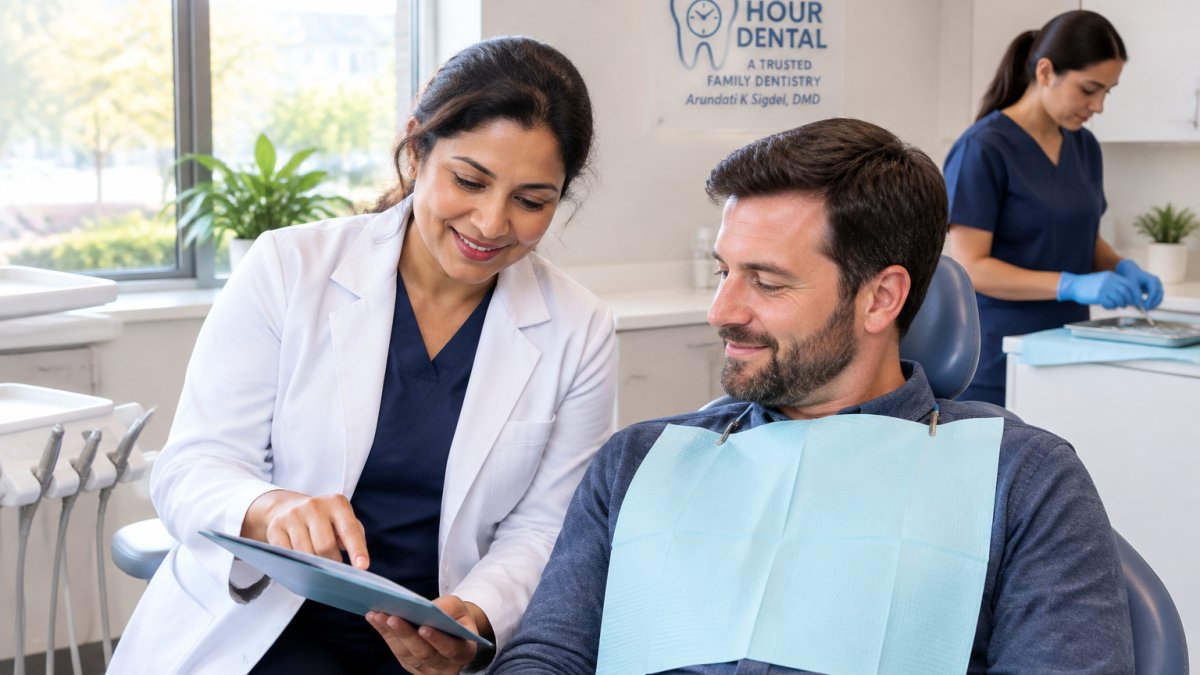
Patient-centered care also shows up in communication. Taking time to answer questions and explain a treatment plan makes a visit easier to understand, especially for nervous patients. If personalized care is a priority for your household, it is worth asking directly how a practice handles anxious patients and how much time it books for a first visit.
Choosing a Family Dentist Who Knows Your Household
Choosing a family dentist starts with three checks: credentials and licensure, the range of services offered, and whether the practice can genuinely handle every age in your home. A good family practice should cover children's dental care, adult preventive care, restorative work, and at least some cosmetic options without sending you to a different office for each need.
Start with a step-by-step guide to choosing a family dentist that walks through the questions to ask. Then verify the basics:
- Confirm the dentist's license and credentials with your state dental board
- Ask which services are handled in-house and which are referred out
- Check whether the practice sees children and older adults
- Read patient reviews for patterns, not just star ratings
- Ask how emergencies are handled after hours
What most guides miss is the value of a first-visit conversation. A short consultation tells you more about fit than any review page. Watch whether the dentist listens, whether the staff explains costs clearly, and whether you feel rushed. That impression is your best predictor of a long-term relationship.
When You Need an Emergency Dentist in Baltimore, MD
An emergency dentist in Baltimore, MD should be able to see you the same day for severe pain, a knocked-out tooth, a broken restoration, or swelling that is getting worse. Dental emergencies do not wait for next week's opening, and a practice that cannot offer same-day appointments is not truly set up for urgent dental care.
Hour Dental offers same-day emergency dental care for patients who need urgent treatment. If you are in pain, call rather than booking online, and describe what happened so the team can prepare. For a knocked-out permanent tooth, keep the tooth moist and get to a dentist as quickly as possible. Learn the first steps for a dental emergency and when to call a dentist right away.
Knowing your nearest urgent option before you need it is the practical move. A nearby practice can mean less time in the car when you or a child is hurting.
What Local Care Really Costs: Insurance, Payment, and Questions to Ask
Cost is the question most families actually have, and it deserves a straight answer. Dental insurance coverage, out-of-pocket costs, and payment options vary widely between practices, so the most reliable approach is to ask before you book and to get key answers in writing.
Start by verifying network participation directly with your insurer. Call the member services number on your dental ID card and confirm whether the specific dentist and practice location are in-network for your plan.
When you request an estimate, ask for it in writing and make sure it separates the insurer's expected payment from your expected out-of-pocket amount. A useful estimate lists the procedure codes, the allowed amount, the estimated insurance benefit, and your patient portion.
Ask these questions on the phone:
- Which insurance plans does the practice accept, and is it in-network for my specific plan?
- What will my estimated out-of-pocket cost be for a cleaning, a filling, or a crown, and can you provide that estimate in writing?
- Are there payment plans for larger treatment, and are there any fees for those plans?
- What happens if my insurance denies a claim or pays less than the estimate?
- Is pre-authorization required for major services, and who submits it?
Review the insurance and payment options to check coverage before switching. For a deeper look at why a tailored approach protects your smile over time, read seven reasons personalized dental care matters.
A verbal estimate is not a guarantee, so ask for it in writing.
How to Evaluate a Neighborhood Practice Before You Switch
Evaluating a local practice before you commit takes about an hour of research and one phone call. Look at the practice's website for credentials, services, and hours. Read recent patient reviews for comments about communication, wait times, and how staff handle nervous patients. Then call and ask how records transfers work, since moving a family's dental history is the step most people dread.
Accessibility matters too. Check parking, building access, and whether the office can accommodate mobility needs or sensory sensitivities. If you have a child or adult with additional needs, ask directly how the team adjusts appointments. A welcoming environment is not a slogan; it shows up in how the front desk answers the phone.
Book Your First Visit at Hour Dental
Finding the right dental home should not feel like a gamble. If you want a local dental practice that treats the whole family, knows your history, and answers cost questions plainly, we would be glad to meet you. Hour Dental has served the Dundalk community for over 40 years, offering same-day emergency dental care, comprehensive general and cosmetic dentistry, and a comfortable, modern environment. We are proud to serve families across Baltimore and the surrounding communities.
Get started with Hour Dental and give your family a dentist they will actually keep.
Schedule your first visit online whenever you are ready.
A dental home is worth choosing carefully, because the relationship shapes your family's oral health for years. If you have been putting off a switch, start with one phone call and one question: does this practice know how to care for everyone in my household? Hour Dental is here to answer that for families across Baltimore County, with same-day emergency care, comprehensive family dentistry, and a team that takes time to listen.
Frequently Asked Questions
What are the benefits of choosing a local dental practice?
A local dental practice usually means shorter travel, easier scheduling, and a team that keeps one record for your whole household. You see familiar faces who know your dental history and treatment preferences, so visits start where the last one ended instead of from scratch. Local offices also tend to answer questions about insurance and out-of-pocket costs directly, since they handle claims in-house. Ask about same-day availability and emergency policies before you commit.
Is a local dentist better than a corporate dental chain?
It depends on what you value. A local dentist vs. corporate dental chain comparison usually comes down to continuity and decision-making. Independent, dentist-owned offices often keep the same provider across visits and set treatment recommendations without corporate quotas. Chains may offer longer hours or more locations. Ask who owns the practice, whether you see the same dentist each time, and how treatment plans are approved. Those answers tell you more than the sign on the door.
What should I look for when choosing a family dentist in Baltimore?
Start with location and hours that fit school and work schedules, then check credentials and licensure through the state dental board. Confirm the practice treats children and adults, handles routine preventive care, and refers to specialists when needed. Read patient reviews for comments about wait times and communication. Ask how they handle dental anxiety, what insurance they accept, and whether they offer same-day appointments for pain.
Can a local practice see me the same day for a dental emergency?
Many neighborhood offices reserve slots for urgent dental care, but availability varies by practice and by day. Call ahead and describe your symptoms so staff can triage you correctly. If you have swelling, uncontrolled bleeding, or a knocked-out tooth, seek care immediately. For an emergency dentist in Baltimore, MD, confirm the office offers same-day appointments and ask what to do if you call after hours.