 Listicle
How Routine Dental Cleanings Protect Your Teeth and Health
Quick Summary
Routine dental cleanings remove plaque and tartar that brushing and flossing miss, which lowers the risk of cavities and gum inflammation. They also give your dentist a chance to spot problems early, when they are easier to treat.
- Tartar cannot be removed by brushing at home and needs professional instruments.
- Gingivitis is often reversible with professional cleaning and better home care.
- A typical routine cleaning takes 30 to 60 minutes.
- Most adults are advised to have a cleaning every six months, though the right interval varies.
- Bleeding gums during brushing are an early sign of gingivitis and should be raised at your visit.
Table of Contents
- How Routine Dental Cleanings Protect Your Teeth and Health
- Why Routine Dental Cleanings Matter for Everyday Oral Health
- Removing Plaque and Tartar That Brushing Misses
- Preventing Cavities, Gum Disease, and Tooth Loss
- Early Detection of Problems and Fresher Breath
- What Happens During a Routine Dental Cleaning Step by Step
- Deep Cleaning vs. Regular Cleaning: Which Do You Need?
- How Often to Get a Dental Cleaning and What It Costs
- Booking Your Next Cleaning at Hour Dental in Dundalk
- Frequently Asked Questions
How Routine Dental Cleanings Protect Your Teeth and Health
Last Updated: November 19, 2026
Why Routine Dental Cleanings Matter for Everyday Oral Health
Routine dental cleanings are the professional maintenance that keeps daily brushing and flossing working. Many patients who brush well still build up tartar in places a toothbrush cannot reach.
Many families assume a cleaning is only about making teeth look brighter. It does help with appearance, but the bigger payoff is preventive. The American Dental Association's guidance on oral health recommends regular professional visits as a core part of preventive care.

Here is what a routine cleaning generally delivers:
- Removal of plaque and hardened tartar
- Lower risk of cavities and gum inflammation
- Fresher breath and cleaner-looking teeth
- Early detection of problems that are easier to treat when small
Our approach to preventive care at Hour Dental focuses on catching issues before they grow into bigger treatments. For a broader view of how regular visits fit into long-term oral health, see our guide on why regular check ups matter.
Removing Plaque and Tartar That Brushing Misses
Plaque is a soft, sticky film of bacteria that forms on teeth every day. If it is not removed, minerals in saliva can harden it into tartar, also called calculus. Once tartar forms, brushing and flossing at home cannot remove it.
Tartar tends to collect along the gumline and between teeth, where brushes struggle to reach. A hygienist uses specialized instruments to remove it safely. Many people notice a smoother, cleaner feel afterward.
Watch out: tartar that sits below the gumline is a sign that gum disease may be starting, and it needs professional attention rather than more aggressive brushing.
Preventing Cavities, Gum Disease, and Tooth Loss
Cavities form when acid produced by bacteria breaks down tooth enamel. Routine cleanings remove the plaque that feeds this process, which lowers the risk of decay. Gingivitis, the early stage of gum disease, is inflammation caused by plaque along the gumline. For a closer look at how small preventive appointments stop these problems from developing, see how small preventive appointments prevent big dental problems.
Untreated gum disease can progress to periodontitis, which damages the bone that holds teeth in place. This is a leading reason adults lose teeth.
It helps to understand the sequence, because each stage calls for a different response:
- Plaque. A soft film of bacteria that forms within hours of brushing. It can be removed at home with brushing and flossing.
- Tartar (calculus). Plaque that has mineralized and bonded to the tooth. It cannot be brushed away and must be removed with professional instruments.
- Gingivitis. Inflammation of the gums, often signaled by redness, swelling, or bleeding when you brush. At this stage, the damage is usually reversible.
- Periodontitis. Inflammation that has spread below the gumline and begun to destroy the bone and ligament holding teeth in place. This stage is managed, not cured, and it is the main pathway to adult tooth loss.
A routine cleaning removes plaque and tartar before they can progress, which is one reason regular visits matter even when your teeth feel fine.
Watch out: bleeding gums are not normal, even if they do not hurt. Bleeding during brushing or flossing is one of the earliest signs of gingivitis and is worth raising at your next visit rather than waiting for pain.
The whole-body connection, and what the evidence actually shows
Many articles link gum health to heart health, stroke, and respiratory conditions. It is worth being precise about what that research does and does not establish. Gum disease is consistently associated with cardiovascular disease, stroke, and poorer blood-sugar control in people with diabetes, and the association is strong enough that major health organizations encourage people with gum disease to be evaluated for those conditions. What the evidence does not show is that a routine cleaning prevents heart disease or stroke.
For respiratory health, the mechanism is more direct: bacteria from the mouth can be aspirated into the lungs, which is a particular concern for older adults and people with swallowing difficulties.
Healthy gums matter more than many people realize. To learn why, read our explainer on why healthy gums matter more than you realize.
Early Detection of Problems and Fresher Breath
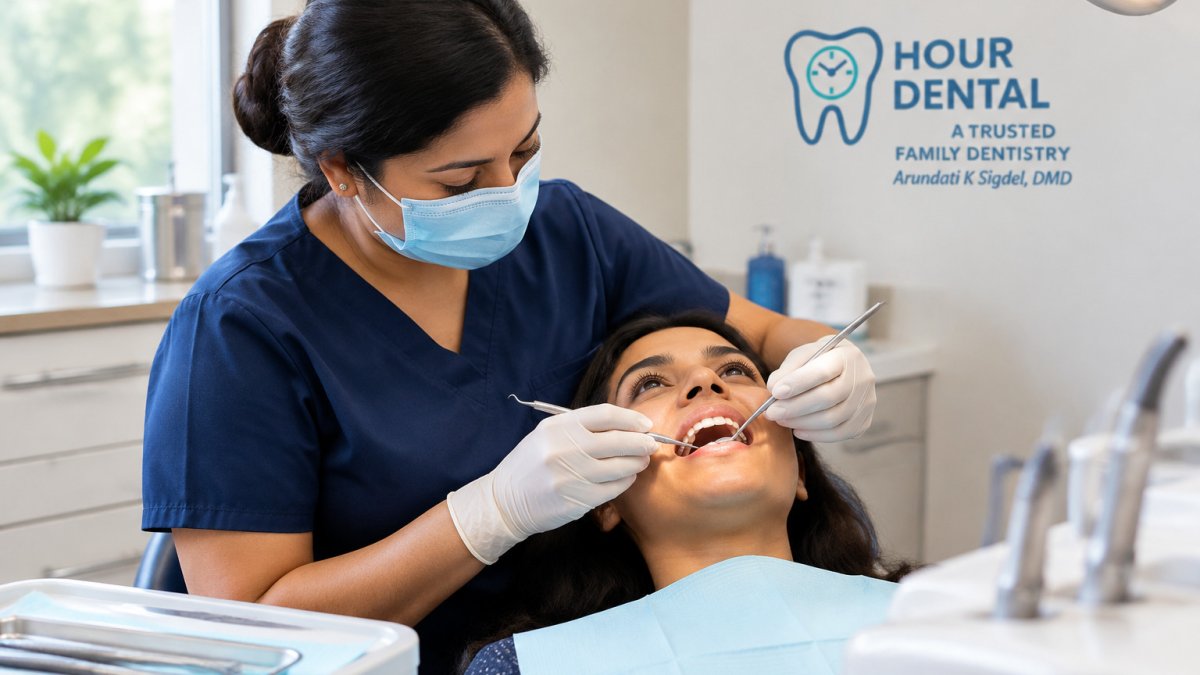
During a cleaning, the dental team checks teeth, gums, and the mouth for signs of trouble. Dental teams can spot some problems, such as small cavities and early gum changes, during routine visits. Finding issues early can make treatment simpler.
Persistent bad breath often comes from bacteria and plaque on the tongue and between teeth, along with gum inflammation. A thorough cleaning removes much of that buildup. If bad breath returns quickly after a cleaning, that is worth mentioning at your visit, since it can point to an underlying issue.
What Happens During a Routine Dental Cleaning Step by Step
A routine cleaning usually takes 30 to 60 minutes, depending on how much tartar is present. Here is the typical sequence:
- Examination. The hygienist reviews your health history and checks for visible problems.
- Scaling. Tartar is removed from above and below the gumline with hand tools or an ultrasonic scaler.
- Polishing. Teeth are polished to remove surface stains and smooth the enamel.
- Flossing. Remaining debris between teeth is cleared out.
- Fluoride treatment. A fluoride application may be added to help strengthen enamel.
- Home care review. Your hygienist explains brushing and flossing habits that fit your mouth.
Some people feel a little pressure or sensitivity during scaling, and patients who are nervous can ask for breaks at any time. Hour Dental aims to provide a gentle, patient-focused experience.
The typical cleaning follows a clear sequence, summarised below.
| Step | What happens | Time |
|---|---|---|
| Examination | Hygienist reviews health history and checks for problems | Before cleaning |
| Scaling | Tartar removed above and below the gumline | Varies with tartar |
| Polishing | Surface stains removed and enamel smoothed | Part of visit |
| Flossing | Remaining debris between teeth cleared | Part of visit |
| Fluoride treatment | Application may strengthen enamel | Optional |
| Home care review | Brushing and flossing habits reviewed | End of visit |
| Whole visit | Routine cleaning length | 30 to 60 minutes |
Deep Cleaning vs. Regular Cleaning: Which Do You Need?
A regular cleaning, also called a prophylaxis, is for healthy gums with little tartar buildup. A deep cleaning, known clinically as scaling and root planing, treats gum disease by cleaning below the gumline and smoothing the tooth roots. It is usually spread over more than one visit and often done with local numbing.
Your dentist decides which you need based on gum measurements and X-rays.
How Often to Get a Dental Cleaning and What It Costs
Most adults are advised to have a cleaning every six months, but the right interval depends on your gum health, tartar buildup, and risk factors. Some patients benefit from visits every three to four months, while others do well with less frequent appointments. Your dental team can recommend a schedule that fits you.
A useful way to think about it is by risk category rather than by a universal rule:
- Low risk. Healthy gums, no bleeding, no cavities in recent years, and good home care. A six-month recall is typical.
- Moderate risk. Occasional bleeding, a history of cavities, or medical conditions such as diabetes that affect gum health. Many practices recommend three- to four-month visits.
- High risk or post-treatment. Patients with a history of periodontitis, current smokers, or those who have completed scaling and root planing are often placed on a periodontal maintenance schedule, commonly every three months, because the goal shifts from prevention to keeping treated disease stable.
This is why two neighbors can both say they get "regular cleanings" and mean very different schedules. The interval is a clinical decision, not a fixed rule.
What a cleaning does and does not treat
A routine cleaning, also called a prophylaxis, is designed for healthy gums. It removes plaque and tartar above the gumline and is not a substitute for treating an established cavity or advanced gum disease. If your dentist finds deep gum pockets, bone loss on X-rays, or tartar below the gumline, the recommendation may shift to scaling and root planing, a deeper cleaning, often spread over more than one visit and usually done with local numbing. Patients are sometimes surprised when a routine visit turns into a deep cleaning, but acting early is what keeps a manageable problem from becoming a larger one.
Insurance, out-of-pocket costs, and what to bring
Cost depends on the type of cleaning, your insurance coverage, and any additional treatment needed. For current pricing, please contact Hour Dental or visit our website for a quote, since pricing depends on individual needs. Many dental plans cover preventive cleanings, and you can check your plan details with your insurer. Before your appointment, it helps to confirm:
- Whether your plan covers a prophylaxis once or twice per year, and whether a waiting period applies.
- Whether the visit will be billed as preventive or periodontal maintenance.
- Your deductible and any annual maximum.
- What to bring: photo ID, your insurance card, a list of medications, and any recent X-rays from a previous dentist.
Appointment length varies with tartar buildup and gum condition; a routine cleaning commonly runs 30 to 60 minutes, and a first visit with X-rays takes longer. If you are anxious or have sensitive teeth, tell the scheduler when you book so the team can plan breaks and comfort measures.
For information on affordable options for families, see our guide to affordable family dentistry in Dundalk.
Booking Your Next Cleaning at Hour Dental in Dundalk
Routine cleanings are one of the simplest ways to protect your teeth and overall oral health. Hour Dental, led by Dr. Arundati Kharel Sigdel, provides comprehensive, gentle care for patients of all ages, and offers same-day emergency dental care.
You can book your next cleaning using our online scheduling.
Frequently Asked Questions
Are dental cleanings actually helpful?
Yes. A professional cleaning removes plaque and tartar that brushing and flossing cannot fully clear, especially along the gumline and between teeth. Tartar only comes off with professional tools. Regular cleanings also give the dentist a chance to check for cavities, gum inflammation, and other problems early, when they are usually simpler and less costly to treat. Cleanings support oral health but do not replace daily brushing, flossing, and regular exams.
How often should you get a routine dental cleaning?
Many adults are advised to have a routine cleaning about every six months, but the right interval depends on your gum health, cavity history, and oral hygiene habits. Some patients with gum disease or a higher risk of decay may need cleanings more often, while others may be fine with a longer interval. Your dentist can recommend a personalized schedule based on your exam findings.
Can a dental cleaning remove tartar?
Yes. Tartar, also called calculus, is hardened plaque that has bonded to the tooth surface and cannot be removed by brushing alone. A dental hygienist uses scaling tools to remove it above and, when needed, below the gumline. A cleaning removes tartar but does not treat cavities or gum disease that has already developed, so an exam is still important.
Are there any disadvantages to getting your teeth cleaned?
Some patients experience temporary tenderness, mild bleeding of the gums, or sensitivity to hot and cold after a cleaning, particularly if their gums are inflamed. A cleaning may also feel uncomfortable for patients with dental anxiety, which is why it helps to tell your dental team about your concerns beforehand. Symptoms that persist or worsen should be reported to your dentist. Cleanings are generally considered safe for most people when performed by a qualified professional.