 How-to
How to Plan Wisdom Teeth Removal in Baltimore
Last Updated: November 12, 2026
Quick Summary
Wisdom teeth removal begins with a dental examination and X-rays to check tooth position, roots, and nearby nerves. Removal is recommended when a wisdom tooth causes pain, infection, decay, gum disease, crowding, or damage to the neighboring molar. A consultation is a common starting point to discuss your options.
- Third molars usually appear between the late teens and mid-twenties.
- A fully erupted, healthy wisdom tooth that meets its opposite may be left alone with monitoring.
- Many people feel noticeably better within a few days, with full gum healing generally taking a few weeks.
- Smoking and straw use in the first week are the most common causes of dry socket.
- A final price generally cannot be quoted over the phone without an exam and X-rays.
Table of Contents
- Starting With a Dental Examination and Imaging
- When Wisdom Teeth Removal Is Recommended
- How the Extraction Procedure Works
- Wisdom Teeth Removal Recovery Time, Day by Day
- Wisdom Teeth Removal Aftercare That Prevents Complications
- What to Eat After Wisdom Teeth Removal
- Wisdom Teeth Removal Cost and Insurance in Baltimore
- Booking Your Wisdom Teeth Consultation at Hour Dental
- Frequently Asked Questions
Starting With a Dental Examination and Imaging
Wisdom teeth removal begins with a careful dental examination, not a same-day decision. Third molars are the last teeth to develop, usually appearing between the late teens and mid-twenties, and they often sit in positions that are hard to see or clean.
A wisdom tooth evaluation generally starts by looking at the whole mouth. A dentist typically checks the gum tissue around the back molars, looks for signs of decay or gum disease, and feels how the teeth meet when you bite.
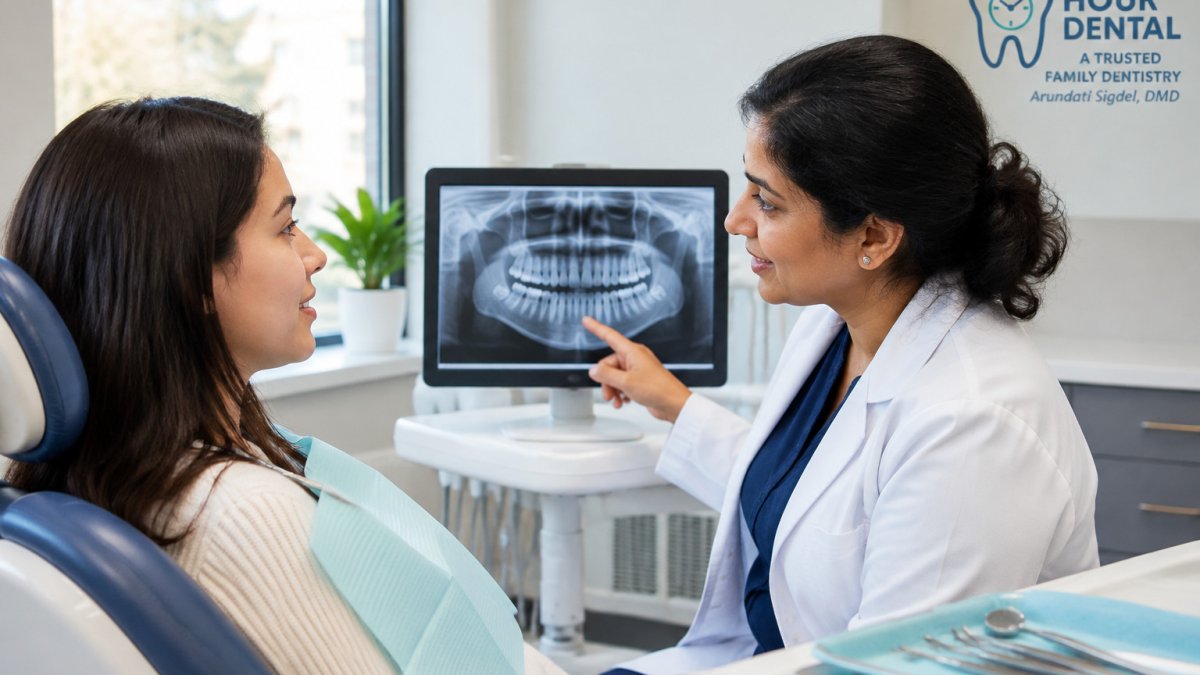
Then dental imaging is typically taken. X-rays show what a visual exam cannot: the roots, the jawbone, and the exact tooth position under the surface.
What X-Rays Reveal About Tooth Position
Dental X-rays show whether a wisdom tooth is fully erupted, partially erupted, or still trapped beneath the gum. They also reveal the shape and angle of the roots and how close each tooth sits to the nearby nerve canal.
That last detail matters. A tooth lying sideways or pressing near a nerve changes the plan, the technique, and the conversation we have with you about risk.
Imaging can also catch problems you cannot feel yet, such as a cyst forming around an impacted tooth or early decay under a partially erupted crown.
When Wisdom Teeth Removal Is Recommended
Removal is recommended when a wisdom tooth causes pain, infection, decay, gum disease, crowding, or damage to the neighboring molar. It is also considered when imaging shows a problem likely to develop, such as a cyst or a tooth pressing into the next molar's root.
Here is what dentists generally look for:
- Impacted tooth: trapped in the jawbone or gum tissue
- Partially erupted tooth: breaks through partway, leaving a flap where bacteria collect
- Repeated infection: swelling or tenderness around the back gum
- Tooth decay or gum disease on or around the third molar
- Crowding that pushes on nearby teeth
- A cyst or bone loss visible on X-rays
Not every wisdom tooth needs to come out. A fully erupted, healthy tooth that meets its opposite and can be cleaned properly may be left alone with regular monitoring.
Deciding on Asymptomatic Third Molars
A wisdom tooth with no symptoms still deserves a real decision, not a shrug. The question is whether the tooth can be kept clean and whether imaging shows a problem forming.
Some impacted teeth sit quietly for years. Others develop decay or a cyst without any warning. Tooth position, age, oral hygiene, and overall health are generally weighed before recommending surgery.
If waiting is chosen, monitoring with regular checkups and updated X-rays is typically used so a small problem does not become a painful one.
How the Extraction Procedure Works
Wisdom tooth extractions generally follow a simple sequence: numb the area, access the tooth, remove it, clean the site, and place stitches if needed. Visit length varies, and complex cases generally run longer.
The general steps are:
- Review and consent. The X-rays are generally reviewed and questions answered.
- Anesthesia. Local anesthesia numbs the area; sedation may be used for anxious patients.
- Access. For a surgical case, a small incision in the gum tissue is typically made.
- Removal. The tooth is loosened and lifted out. Some teeth are sectioned into smaller pieces first.
- Clean and close. The site is rinsed and stitches are placed when needed.
- Aftercare instructions. Written guidance and a follow-up plan are typically provided.
You will feel pressure during the procedure, not sharp pain. That pressure is normal and expected.
If you want to see how our team handles extractions, you can review our tooth extraction service before you book.
Simple Versus Surgical Extraction
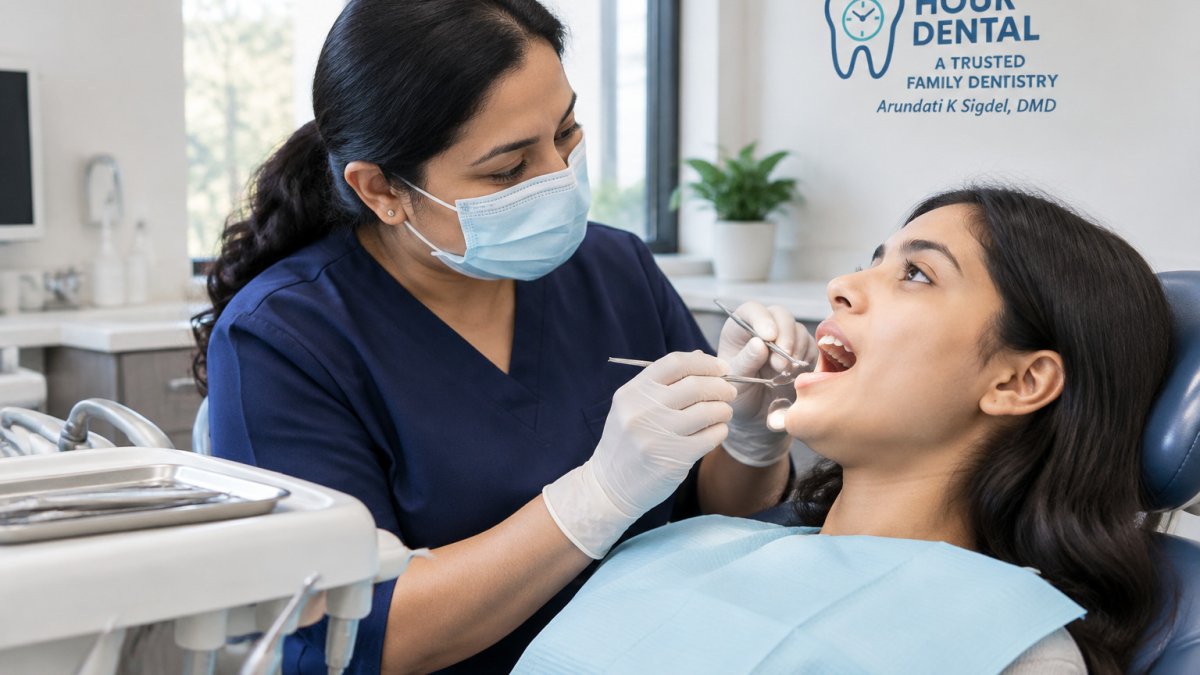
A simple extraction is for a tooth that has fully erupted and can be lifted out with a dental instrument. A surgical removal is for an impacted or partially erupted tooth that needs an incision, bone removal, or sectioning.
Neither is "better." The right approach depends on tooth position and root shape, both of which the X-rays reveal.
Anesthesia Options and Sedation Safety
Options generally range from local anesthesia alone to sedation for patients who feel anxious. Each choice has trade-offs, and a dentist typically matches it to health history and comfort level.
If you are nervous, tell us early. We can walk you through sedation choices and share practical ways to manage dental anxiety before your visit.
Watch out: if you choose sedation, you generally cannot drive yourself home. Arrange a ride in advance, because the effects can linger for hours.
Wisdom Teeth Removal Recovery Time, Day by Day
Many people feel noticeably better within a few days, with full healing of the gum tissue generally taking a few weeks. Recovery time varies with how deep the tooth sat and how many teeth were removed.
- Day 1: Rest. Expect some bleeding, swelling, and drowsiness from anesthesia. Use a cold compress.
- Days 2-3: Swelling often peaks. Keep up ice, rest, and any prescribed medication.
- Days 4-7: Swelling eases. Many patients return to work or school. Stitches may dissolve.
- Week 2: Most soft tissue has healed. Gentle chewing is usually comfortable.
- Weeks 3-4: The socket continues filling in beneath the surface.
Bruising on the cheek or jaw is common and fades on its own. Mild jaw stiffness can last a week or two.
Here is how recovery typically unfolds after wisdom teeth removal.
| Timeframe | What to expect |
|---|---|
| Day 1 | Rest; some bleeding, swelling, drowsiness; use a cold compress |
| Days 2-3 | Swelling often peaks; keep up ice, rest, prescribed medication |
| Days 4-7 | Swelling eases; many return to work or school; stitches may dissolve |
| Week 2 | Most soft tissue has healed; gentle chewing usually comfortable |
| Weeks 3-4 | The socket continues filling in beneath the surface |
Wisdom Teeth Removal Aftercare That Prevents Complications
Good aftercare can help a recovery stay smooth. The main risks are infection and dry socket, a condition where the protective blood clot dislodges from the socket.

The following habits are generally recommended for the first week:
- Keep gauze in place for the first few hours if bleeding continues
- Apply a cold compress for 15-20 minutes at a time
- Take prescription pain medication exactly as directed
- Skip straws, smoking, and vigorous rinsing
- Start gentle saltwater rinses after the first 24 hours
- Brush carefully, avoiding the extraction site
- Attend your follow-up appointment
Watch out: smoking and straw use in the first week are the most common causes of dry socket. Both create suction that pulls the clot loose.
Contact a dental professional promptly if you notice fever, worsening pain after day three, pus, or bleeding that will not stop.
What to Eat After Wisdom Teeth Removal
Soft foods and cool temperatures are the rule for the first few days. Your goal is nutrition without disturbing the blood clot.
Good choices include:
- Yogurt, pudding, and applesauce
- Mashed potatoes and soft scrambled eggs
- Smoothies eaten with a spoon, never a straw
- Broth, soup, and protein shakes
- Soft pasta and well-cooked vegetables later in the week
Avoid hot, spicy, crunchy, or chewy foods at first. Nuts, chips, and seeds can lodge in the socket. Carbonated drinks and alcohol slow healing, so hold off on both.
Reintroduce solid food gradually. If chewing hurts, wait another day.
Wisdom Teeth Removal Cost and Insurance in Baltimore
Cost is one of the first questions patients ask. Wisdom teeth removal is generally priced by case rather than by a single flat fee.
What drives the estimate:
- Impaction level. A fully erupted tooth is simpler to remove than one trapped in the jawbone or lying sideways.
- Root shape and position. Curved or widely spread roots take longer and may require sectioning.
- Number of teeth. Removing all four costs more than removing one.
- Anesthesia choice. Local anesthesia alone is the least expensive option; IV sedation and general anesthesia add cost and monitoring requirements.
- Imaging. X-rays or a cone beam scan may be needed to plan the surgery.
A final price generally cannot be quoted over the phone, because an accurate estimate typically requires an exam and X-rays. Contact the office for current pricing or a quote.
Insurance often covers part of the cost when removal is medically necessary. Most dental plans cover a percentage of surgical extractions after any deductible, up to an annual maximum, but the percentage and maximum differ widely by plan. You can review the insurance plans we accept before your visit.
If you have no insurance, ask the office about available payment options. Many practices offer payment plans or third-party financing, and some patients schedule treatment in stages to spread out the cost.
Watch out: a quote that sounds unusually low may not include imaging, sedation, or the follow-up visit. Ask for a written estimate that lists every component before you schedule.
Booking Your Wisdom Teeth Consultation at Hour Dental
Hour Dental, led by Dr. Arundati Kharel Sigdel, serves families across Dundalk, Highlandtown, and Baltimore County with gentle, patient-focused care.
If you are searching for wisdom teeth removal in the Baltimore area, a consultation is a common starting point to discuss your options.
- Same-day emergency dental care for sudden pain or swelling
- Over 40 years of service to the Dundalk community
- Consistent 5-star patient reviews
- Care for the whole family under one roof
Have questions before you call? Read our FAQ for quick answers, or contact our office to schedule.
A painful or impacted wisdom tooth rarely improves on its own, and waiting usually makes the visit more complicated. Hour Dental offers same-day emergency care, gentle sedation options, and a comfortable setting designed for nervous patients. Get started with Hour Dental and get a clear plan for your wisdom teeth.
Frequently Asked Questions
How long is recovery from wisdom teeth removal?
Most people see the worst swelling and soreness fade within three to four days, with steady improvement over one to two weeks. Simple extractions often feel manageable in a few days, while surgical removal of impacted third molars can take longer. Your wisdom teeth removal recovery time depends on tooth position, how many teeth come out, and how closely you follow aftercare instructions. Plan for lighter duties for the first few days and avoid strenuous activity for about a week.
What can I eat after wisdom teeth removal, and when?
Stick to cool, soft foods for the first 24 hours: yogurt, applesauce, smoothies without seeds, and mashed potatoes. Over the next few days, add soft proteins like scrambled eggs and well-cooked pasta. Avoid crunchy, spicy, hot, or seedy foods, and skip straws entirely for at least a week because suction can dislodge the blood clot and cause dry socket. Chew away from the extraction sites and drink plenty of water.
When should I call a dentist after wisdom teeth removal?
Call your dentist if bleeding continues heavily beyond 24 hours, swelling worsens after day three, you run a fever, or pain keeps increasing instead of easing. A bad taste with throbbing pain can signal dry socket, which needs professional treatment. Difficulty swallowing or breathing, or numbness that does not fade, warrants immediate attention. Hour Dental offers same-day emergency dental care for sudden pain or injury, so call rather than wait it out.
What does wisdom teeth removal cost, and does insurance help?
Wisdom teeth removal cost varies with the number of teeth, whether they are impacted, and the anesthesia you choose. Many dental plans cover part of surgical extractions as a covered procedure, though percentages and annual maximums differ by plan. Ask for a written estimate before scheduling and check your plan's coverage for sedation, which is sometimes billed separately. Contact the office for a current quote.