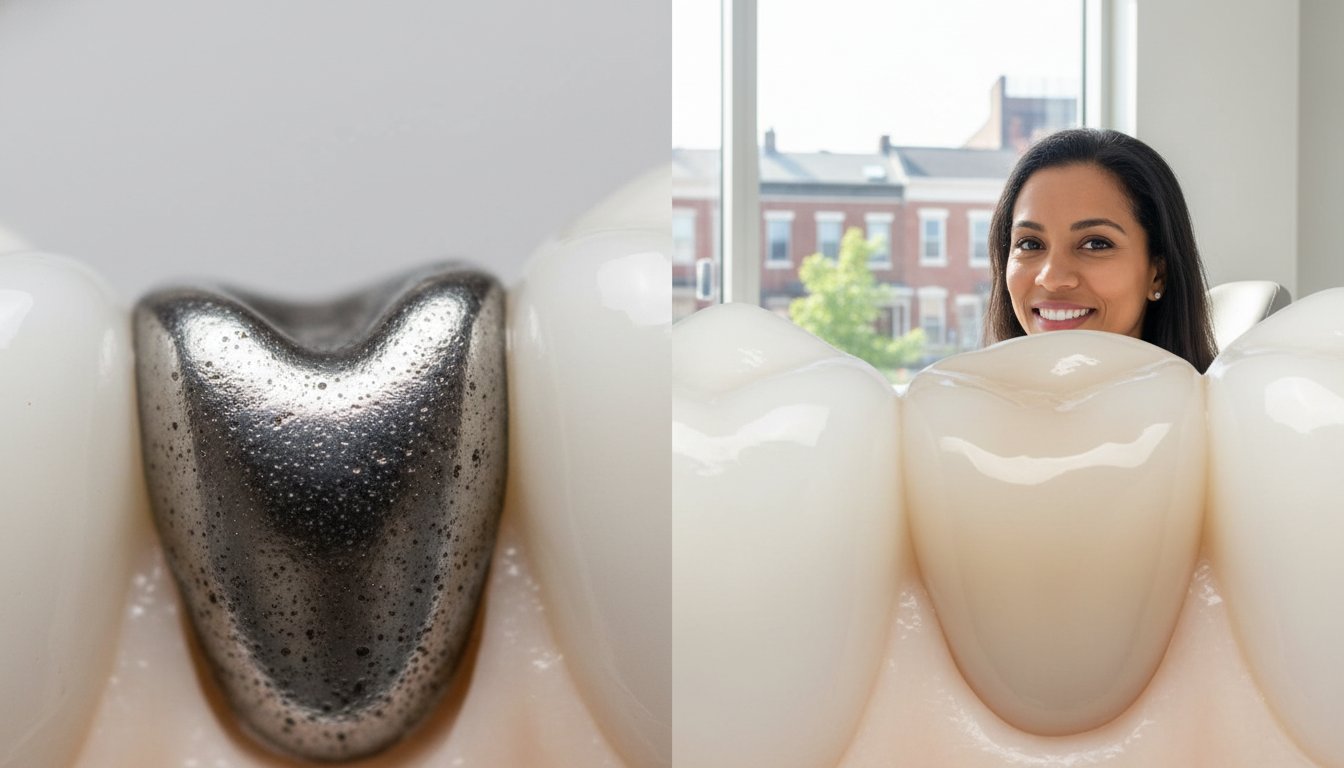
What if the secret to a durable, lifelong smile isn't found in the strongest metal, but in how well a material actually bonds to your natural tooth? Most of our neighbors grew up with silver spots in their smiles, and you've likely felt that familiar worry about whether those old restorations are still safe or if they make your teeth look noticeable. When weighing composite fillings vs amalgam, it's easy to feel caught between the classic durability of metal and the modern beauty of resin. You shouldn't have to choose between a healthy body and a beautiful smile.
We understand that dental decisions often come down to a mix of safety concerns and budget realities. This guide will clarify the latest 2026 safety standards, including the global shift away from mercury-based materials and the newest FDA recommendations for families. You'll discover how modern composite technology now rivals the strength of traditional silver while offering a seamless, natural look. We will walk through the longevity, health implications, and clinical benefits of each option so you can make an informed choice for your long-term wellbeing and confidence.
Key Takeaways
- Learn the fundamental differences between traditional silver alloys and modern glass-particle resins to understand how each material interacts with your natural tooth structure.
- Compare the long-term durability and aesthetic impact of composite fillings vs amalgam to decide whether invisible results or maximum lifespan is your top priority.
- Get clarity on the 2026 safety guidelines regarding mercury and biocompatibility so you can feel confident and relaxed about the materials used in your restorative care.
- Discover the five specific factors our local experts use to determine the best restoration for your unique bite, from the location of the cavity to the size of the repair.
- See how a conservative, patient-centered approach at Hour Dental helps you achieve long-term personal confidence without compromising your budget or your smile's natural beauty.
What Are Composite and Amalgam Fillings? The Basics Explained
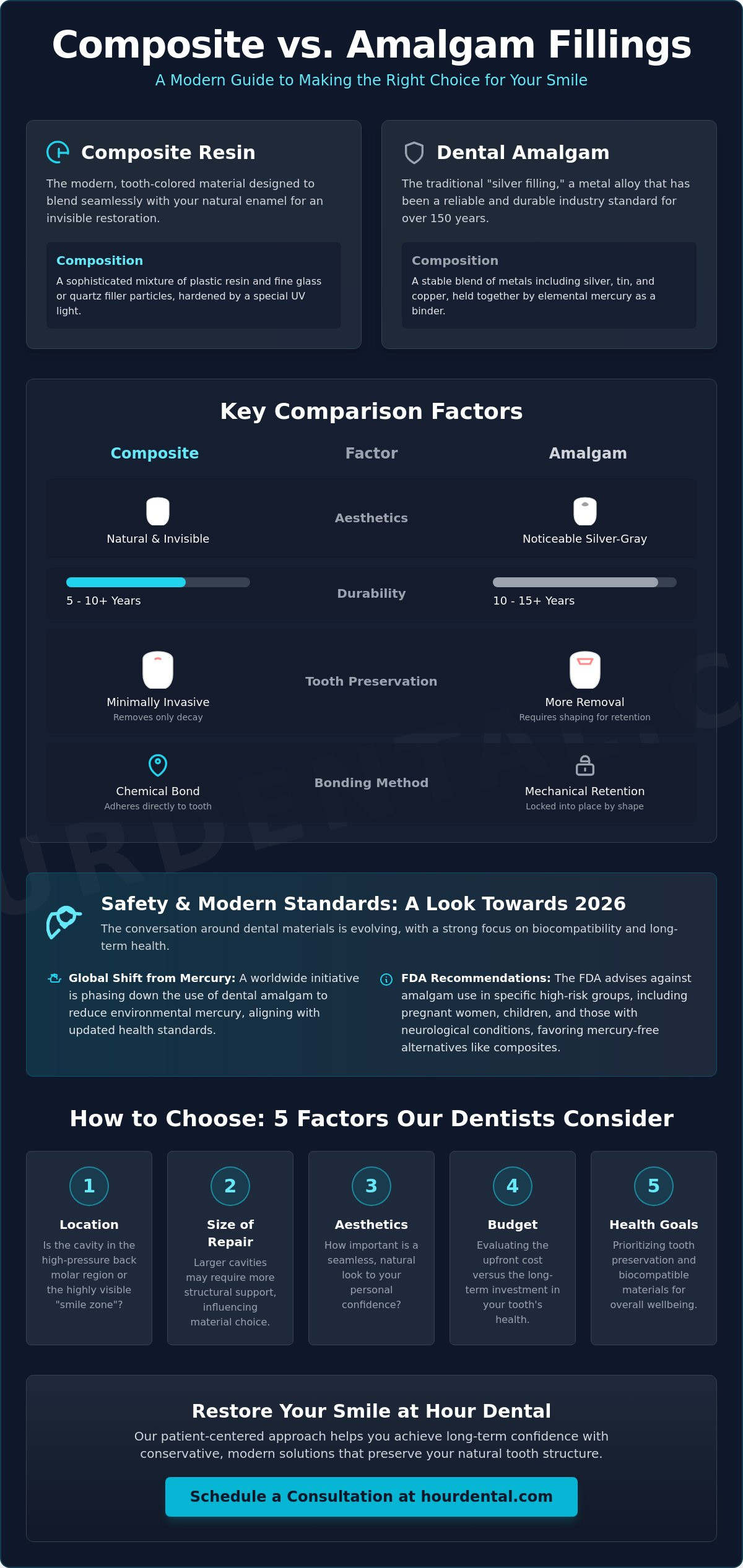
Understanding the core materials used to restore your teeth is the first step toward making a choice that fits your lifestyle and health goals. When we discuss composite fillings vs amalgam, we are looking at two very different technologies with distinct histories and chemical properties. Dental amalgam, often referred to as "silver fillings," is a metal alloy that has served as a reliable industry workhorse for over 150 years. On the other hand, composite resin is a modern, tooth-colored material designed to blend seamlessly with your natural enamel, offering a more discreet solution for your smile.
The way these materials stay in your tooth is a major point of difference. Amalgam requires what dentists call "mechanical retention." This means the tooth must be shaped in a specific way to lock the metal in place, which sometimes involves removing a small amount of healthy tooth structure. Composite resins use advanced chemical bonding. This adhesive approach allows for a more conservative treatment because the material sticks directly to the tooth surface. This shift represents a broader movement in dentistry toward minimally invasive restorations that preserve as much of your natural tooth as possible, helping you maintain a stronger smile for the long haul.
Whether you're visiting us from nearby neighborhoods like North Point Village or Edgemere, we want you to feel like you're in a safe haven where your comfort comes first. We believe that clarity leads to confidence, so let's look closer at what these materials are actually made of.
The Composition of Dental Amalgam
Amalgam is a blend of several metals, typically including silver, tin, and copper. Elemental mercury is used as a binder to hold these metals together, creating a durable, putty-like material that hardens quickly once placed. Because of its metal content and the presence of mercury, The dental amalgam controversy has been a topic of discussion for decades. While it's incredibly strong and has a long legacy of success in restorative dentistry, its silver-gray appearance makes it very noticeable, especially in the "smile zone."
The Science Behind Modern Composite Resins
Modern composites are engineered from a sophisticated mixture of plastic resin and fine glass filler particles. This combination creates a material that's both flexible and strong enough to withstand daily chewing. Once the resin is placed, a specialized UV light is used to "cure" or harden the filling instantly. The biggest benefit for our patients is the ability to custom-match the shade to your existing teeth. This ensures your dental work remains your little secret, providing a boost to your long-term personal confidence every time you laugh or speak.
The Great Debate: Comparing Durability, Aesthetics, and Cost
Choosing between composite fillings vs amalgam often feels like a trade-off between how your smile looks and how long the restoration will last. For decades, silver fillings were the undisputed champions of durability, especially for those heavy-duty back molars that handle the brunt of your chewing. However, as we move through 2026, the conversation has shifted. Modern dental technology has transformed composite resins into formidable competitors that no longer require you to sacrifice strength for beauty. We see many patients who are surprised to learn that the choice involves more than just color; it’s about the very foundation of your tooth’s health.
Tooth preservation is a critical factor that often goes overlooked in the cost discussion. Because amalgam doesn't bond to the tooth, a dentist must often remove a larger portion of healthy enamel to create a "pocket" that locks the metal in place. Composite resins are different. They utilize a sophisticated adhesive process that bonds the material directly to the existing tooth structure. This allows for a much more conservative approach. By keeping more of your natural tooth intact, you are often investing in a stronger dental foundation that may prevent the need for more complex treatments like crowns or root canals later on.
When evaluating the financial side, it is helpful to look at the big picture. A comprehensive clinical and economic review of filling materials suggests that while the initial investment for composite may be higher, the long-term value is found in its biocompatibility and conservative application. Many insurance plans have updated their coverage to reflect the growing preference for tooth-colored materials, though some "least expensive alternative" clauses still exist. If you have questions about your specific coverage, a quick dental exam can help clarify your options and provide a clear path forward for your care.
Longevity and Wear Resistance
Amalgam is famous for lasting 10 to 15 years, standing up to the intense pressure of grinding and clenching. Historically, composites trailed behind with a 7 to 10 year lifespan. That gap is closing fast. The 2026 generation of nano-hybrid composites features smaller, more densely packed filler particles that significantly improve wear resistance. These advancements mean your "white" filling is now better equipped to handle daily stress. Of course, your personal habits, like brushing twice a day and avoiding sugary snacks, remain the biggest predictors of how long any restoration will last.
Aesthetic Integration and Confidence
The psychological impact of a metal-free smile is significant. Many of our neighbors feel a boost in their long-term personal confidence when they no longer have to worry about dark spots showing when they laugh. Amalgam can also expand and contract over time, which occasionally leads to a grayish tint in the surrounding tooth structure. Composite resin avoids this "tattoo" effect. It can even be used to subtly reshape chipped teeth or close small gaps, making it a versatile tool for creating a seamless, healthy appearance that feels entirely natural.
Addressing Safety Concerns: Mercury, Biocompatibility, and Modern Standards
For many of our neighbors in the Baltimore area, the mention of mercury in dental work can spark immediate worry. It's a topic that often comes up during a routine visit, especially as more people prioritize holistic health and material safety. When comparing composite fillings vs amalgam in 2026, the conversation has evolved far beyond just strength and cost. Safety is personal. While the American Dental Association maintained its support for amalgam as a safe option for the general population in February 2026, the global landscape is changing rapidly. The parties to the Minamata Convention on Mercury recently decided on a global phase-out of the manufacture and import of dental amalgam by 2034, following the European Union's total ban that took effect on January 1, 2025.
The primary concern involves "elemental mercury" vapor, which can be released in trace amounts during the placement or removal of silver fillings. The FDA currently recommends that high-risk groups avoid amalgam whenever possible. This includes pregnant women, nursing mothers, children under six, and individuals with existing neurological or kidney issues. Because we want our practice to be a safe haven for every family, we focus on providing clear information so you can choose the material that best supports your long-term personal confidence. A recent systematic review of filling failure rates and safety profiles helps bridge the gap between clinical data and patient peace of mind.
What the Science Says About Mercury
It helps to distinguish between different types of mercury. The mercury found in certain fish is methylmercury, while dental fillings use elemental mercury. Once hardened, amalgam is considered stable for most adults. However, for those with metal sensitivities or those in high-risk categories, the shift toward resin is often the preferred path. We don't recommend removing perfectly functional silver fillings unless it's medically necessary or the restoration is showing signs of decay or structural failure.
Biocompatible Alternatives and Holistic Trends
We've seen a rising interest in "green" dentistry across Maryland, with more patients asking for materials that work in harmony with the body. Our team prioritizes patient comfort by utilizing high-quality, BPA-free composite resins. These materials are designed to be highly biocompatible, meaning they're less likely to cause sensitivities or adverse reactions. By choosing modern, tooth-colored restorations, you're opting for a solution that respects both your oral health and your overall systemic wellbeing.
How to Choose: 5 Factors Our Dundalk Dentists Consider
Every tooth in your mouth has a unique job to do, which is why the decision between composite fillings vs amalgam isn't a one-size-fits-all solution. Our team at Hour Dental looks at your oral health through a personalized lens, considering how you live, eat, and smile in our Dundalk community. We want your restoration to be as functional as it is beautiful, ensuring your long-term personal confidence remains intact. While previous sections explored the chemistry of these materials, choosing the right one for your specific cavity requires a more clinical look at your daily habits and your tooth's anatomy.
The 'Smile Zone' vs. The 'Molar Zone'
Location is often the most significant deciding factor. For your front teeth, known as the incisors and canines, composite resin is the non-negotiable choice because it allows for a seamless, invisible repair. However, for those heavy-duty molars in the back that help you enjoy Maryland crab cakes and other hearty local foods, the choice becomes more nuanced. We evaluate the specific stresses placed on these back teeth during a dental check up Dundalk to ensure the material we choose won't crack under pressure.
Navigating the Costs of Restorative Care
Budget realities are a part of every dental conversation. Composite fillings typically require a higher initial investment because the bonding process is more technique-sensitive and takes more time to complete. You should also be aware of "alternate benefit" clauses in many Maryland dental plans. These clauses often mean the insurance provider will only cover the cost of an amalgam filling, leaving you to pay the difference for a tooth-colored upgrade. If a cavity is exceptionally large and has compromised the majority of your tooth, we might suggest affordable dental crowns Baltimore as a more cost-effective, long-term solution than a massive filling that might fail.
Your bite force and personal habits play a silent but vital role in this decision. If you clench or grind your teeth at night, the edges of a composite filling can sometimes wear down faster than metal. We also look at the size of the restoration. Small cavities are perfect for the conservative bonding of composite resin, which helps keep more of your natural enamel. For much larger restorations, the structural integrity of the tooth becomes the priority. We act as your problem-solvers, weighing your desire for a natural-looking smile against the mechanical needs of your bite to find the most durable path forward.
If you're unsure which material is right for your needs, schedule a personalized consultation with our welcoming team today.
Restoring Your Smile at Hour Dental: Personalized Filling Solutions
At Hour Dental, we believe that choosing between composite fillings vs amalgam shouldn't be a source of stress or confusion. Dr. Sigdel takes a conservative, patient-centered approach to every restoration, focusing on preserving as much of your natural tooth structure as possible. We don't just see a cavity; we see a neighbor who deserves to feel confident and comfortable. By prioritizing minimally invasive techniques, we help ensure your smile stays strong and beautiful for years to come. Our goal is to move the conversation away from technical procedures and toward your long-term personal confidence.
Transparency is the foundation of the trust we build with our patients. We utilize high-definition intraoral cameras during your exam so you can see exactly what we see on a chairside monitor. This technology allows us to point out areas of decay or structural wear in real-time, giving you total clarity on your options. Whether you're considering a tooth-colored resin for a front tooth or discussing the merits of different materials for a back molar, you'll have all the information needed to make the healthiest, most cost-effective choice for your care.
Expert Care in the Heart of Dundalk
Our practice is proud to be a reliable community fixture, serving families from North Point Blvd to Essex and all the residential areas in between. We've designed our office to feel like a safe haven, blending professional clinical authority with a warm, neighborly vibe that alleviates common dental anxieties. We know that dental needs don't always happen during a scheduled cleaning. If you're experiencing sudden, sharp pain from a deep cavity or a broken restoration, our team is highly experienced as an emergency dentist Dundalk MD, providing same-day relief and urgent care when you need it most.
Your Journey to a Confident Smile
We've streamlined our filling appointments to be as gentle and efficient as possible. From the moment you walk through our doors, our nurturing staff works to ensure a relaxed experience for every member of your family, from toddlers getting their first restoration to seniors maintaining their lifelong smiles. We use advanced numbing techniques and a light touch to ensure your visit is entirely painless. After the material is placed and cured, we carefully shape and polish the restoration to match the natural contours of your bite, leaving you with a result that feels and looks completely natural. Your health and comfort are our primary mission. Book your appointment today at Hour Dental and let us help you achieve a smile you're proud to share.
Securing Your Smile's Future with Informed Choices
Deciding between composite fillings vs amalgam is about more than just picking a color; it's about choosing the technology that best supports your long-term health and personal confidence. We've explored how modern nano-hybrid resins now rival the durability of traditional metals while allowing for a more conservative, tooth-saving approach. With the global shift toward mercury-free materials, you can feel reassured that choosing a tooth-colored restoration is a choice that aligns with the highest safety standards of 2026.
Led by Dr. Arundati Kharel Sigdel, DDS, our practice has served as a trusted community fixture in the Baltimore area for years. We pride ourselves on being a safe haven for every family, offering a gentle touch and a neighborly vibe that makes even restorative work feel comfortable. If you're experiencing sudden discomfort, remember that we offer emergency same-day appointments to get you back to feeling your best as quickly as possible. You don't have to navigate these decisions alone.
Schedule Your Restorative Consultation at Hour Dental Today. We look forward to helping you achieve a healthy, radiant smile that lasts a lifetime.
Frequently Asked Questions
Are composite fillings as strong as silver ones?
Modern nano-hybrid composite resins are designed to withstand the heavy chewing forces of your back molars quite effectively. While amalgam has a long legacy of extreme durability, advancements in 2026 have made the strength gap between composite fillings vs amalgam nearly negligible for most patients. These tooth-colored materials bond directly to your enamel, which can actually help reinforce the remaining tooth structure and prevent future fractures.
How much more do composite fillings cost compared to amalgam?
Composite restorations typically involve a higher initial investment because the procedure is more complex and time-consuming for the dentist to perform. The process requires a meticulous bonding technique and specialized light-curing equipment to ensure a long-lasting result. We always provide a clear and detailed breakdown of costs during your visit so you can make a budget-conscious choice that supports your long-term personal confidence.
Is it safe to keep my old silver fillings?
The FDA does not recommend the removal of existing amalgam fillings that are in good condition unless it is medically necessary. If your silver fillings are functional and free of decay, keeping them is generally the safest and most conservative approach for your oral health. We monitor the integrity of your older restorations during every dental exam to ensure they aren't leaking or causing structural stress to your teeth.
Do white fillings stain over time with coffee or tea?
Modern composite resins are highly resistant to staining, though they can pick up slight discoloration over several years if you frequently enjoy coffee, tea, or red wine. Unlike natural enamel, composite material doesn't respond to professional whitening treatments once it has been placed. If staining becomes noticeable after a few years, we can often polish the surface during your cleaning to restore its original luster.
Does dental insurance in Maryland cover composite fillings on back teeth?
Many Maryland dental plans include an "alternate benefit" clause, which means they may only pay the amount for a silver filling even if a tooth-colored one is used. In these cases, the patient is responsible for the difference in cost. Our team is happy to help you navigate your specific policy details so you understand your coverage and out-of-pocket responsibilities before we begin any restorative work.
How long does the procedure take for a composite vs. amalgam filling?
A composite filling usually takes about 10 to 20 minutes longer to place than a traditional amalgam restoration. This extra time is necessary for the precise layering process and the careful use of a UV curing light to harden the material. We prioritize your comfort throughout this process, ensuring you feel relaxed and cared for in our gentle, community-focused office environment.
What happens if a silver filling starts to leak or crack?
When a silver filling leaks or cracks, it creates a tiny gateway for bacteria to reach the sensitive inner parts of your tooth. This can lead to secondary decay that isn't always visible without professional imaging. If we detect a failing restoration, we'll recommend a solution to protect the tooth's structural integrity and prevent the need for more complex treatments like root canals or extractions.
Can I replace all my silver fillings with white ones for cosmetic reasons?
You can choose to replace silver fillings for aesthetic reasons, but we recommend a tooth-by-tooth evaluation to ensure it is the healthiest path for your smile. Removing a functional filling involves some loss of healthy tooth structure, so it's a decision we make together based on your goals for a natural-looking smile. We'll show you the condition of your current fillings using our intraoral cameras to help you decide.


