
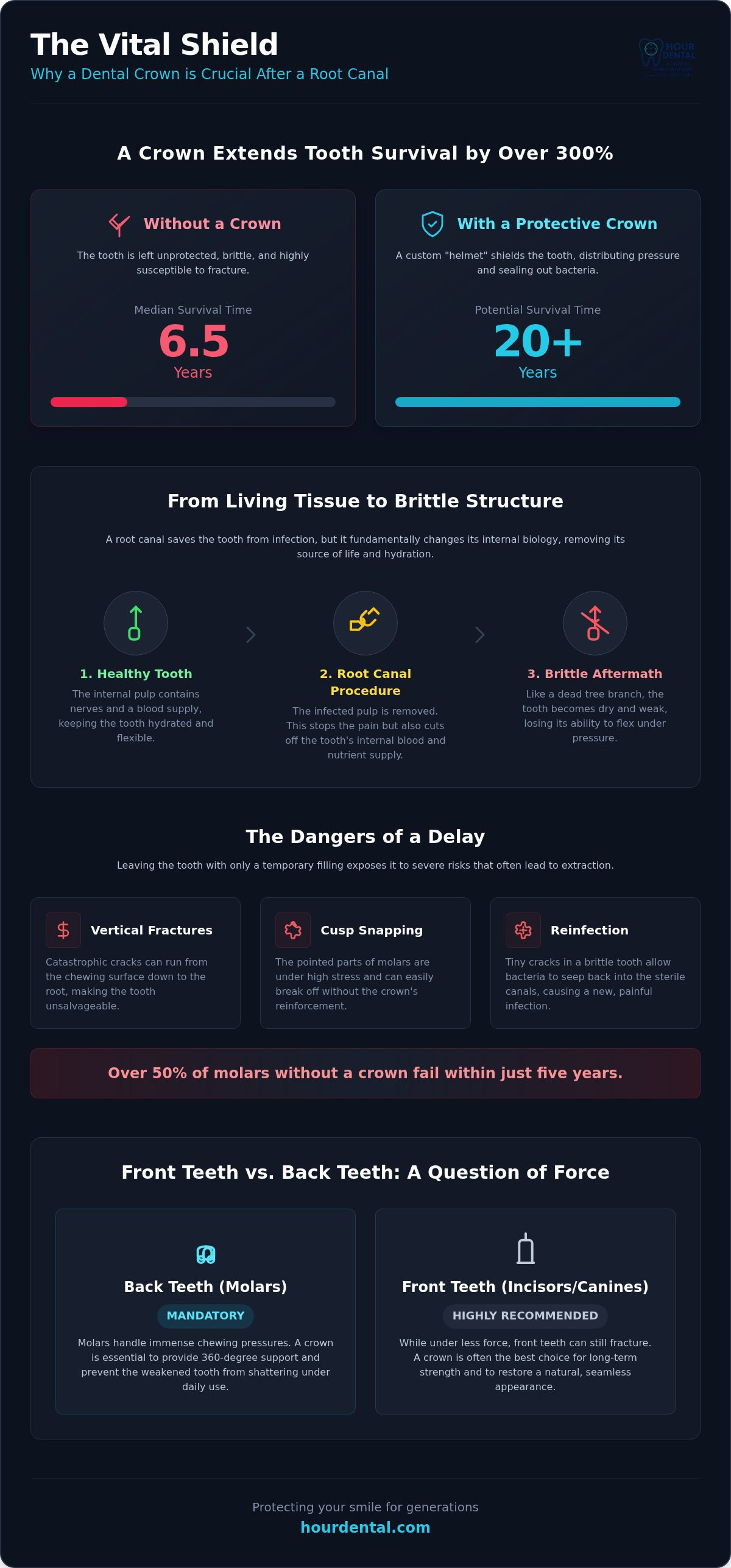
Did you know that a tooth without a restoration after a root canal has a median survival time of only 6.5 years, whereas one protected by a crown can last over twenty years? It's a massive relief to finally be out of pain after your procedure, so it is completely natural to wonder why you need a dental crown after root canal when the tooth already feels "fixed." You might feel anxious about another appointment or worry about the impact on your family budget, but leaving that tooth unprotected makes it brittle and highly susceptible to painful fractures during your next meal.
At Hour Dental, we focus on providing our Dundalk neighbors with professional reassurance and gentle care that protects your long-term wellbeing. This article explains why a porcelain crown is the critical final step to ensuring your tooth functions like a natural one while preventing future extractions. We'll look at the latest digital workflows that make restorations more accurate and how this simple shield provides the armor your tooth needs to survive the daily pressures of life in Baltimore. You'll discover how we turn a complex dental need into a path toward Healthy Smiles that last for generations.
Key Takeaways
- Understand why a root-canal-treated tooth becomes brittle like dried wood and why it needs an external "helmet" to prevent painful fractures.
- Discover the specific reasons why a dental crown after root canal is mandatory for molars to handle the intense pressure of daily chewing.
- Learn about the modern restorative process at Hour Dental, including how we reshape the tooth for a comfortable, natural-looking porcelain fit.
- See how choosing a protective crown can extend your tooth's life from a few short years to over two decades of functional use.
- Explore how Dr. Arundati Kharel Sigdel provides gentle, affordable restorative care that builds long-term confidence for families in Dundalk and Essex.
Understanding the Relationship Between Root Canals and Dental Crowns
You’ve just finished your root canal treatment, and the throbbing pain that kept you up at night is finally gone. It is a moment of immense relief for our Dundalk neighbors, but the journey to a fully restored smile isn't quite finished yet. Think of your tooth as a historic home in the Baltimore area. If you repair the internal plumbing but leave the roof wide open to the elements, the structure remains at risk. A dental crown after root canal serves as that essential roof, providing a protective seal that ensures your tooth stays healthy and functional for decades.
The Internal vs. External Restoration
A root canal is an internal procedure where the dentist removes infected pulp from the deep chambers of your tooth. This process stabilizes the foundation and stops the spread of decay, but it also leaves the tooth hollowed out. While the internal foundation is now clean and sterile, the portion of the tooth visible above the gumline is significantly weakened. A Crown (dental restoration) is necessary because teeth that have undergone root canal treatment are naturally more prone to fractures and need a custom cap to distribute chewing forces evenly. By placing this permanent restoration, we create a barrier that prevents bacteria from leaking back into the freshly cleaned canals, which is the most common cause of reinfection.
Why a "Fixed" Tooth Still Needs Protection
Many patients believe that once the nerves are removed and the pain is gone, the tooth is suddenly indestructible. This is a dangerous misconception that can lead to unexpected dental emergencies during a family dinner. Without the hydration and nutrients provided by the living pulp, the remaining tooth structure becomes brittle. A temporary filling is often placed immediately after your endodontic therapy, but this material is soft and designed only for short-term use. It will eventually wear down or leak, exposing your investment to new decay. At Hour Dental, our goal is to move you past this temporary phase toward a safe, permanent solution. Root canal therapy eliminates the internal infection to stop your pain, while the dental crown provides the external reinforcement required to keep the tooth functional and intact for a lifetime.
Why a Root-Canal-Treated Tooth Becomes Brittle and Vulnerable
While the root canal procedure successfully removes the infection, it fundamentally changes the biology of your tooth. Once the pulp is removed, the tooth no longer has its internal blood supply. This means it loses its natural hydration and elasticity. Think of it like a branch on a tree in a local Dundalk park; a living branch is flexible and can withstand the wind, but a dead branch becomes dry and snaps easily. Your tooth undergoes a similar shift, becoming what dentists often call "brittle."
The Biological Shift After Pulp Removal
The loss of internal moisture makes the remaining enamel and dentin significantly weaker. According to the Cleveland Clinic, a crown is the standard of care to cover and protect these vulnerable structures. Beyond just the loss of hydration, the previous decay that necessitated the root canal has likely already thinned the tooth's walls. Traditional composite fillings are excellent for small cavities, but they cannot provide the 360-degree structural support needed to hold a weakened tooth together. Without a dental crown after root canal, the tooth is forced to handle intense occlusal forces, the pressure from chewing, without its natural internal reinforcement.
- Vertical Fractures: These are cracks that run from the top of the tooth down to the root, often requiring a full extraction.
- Cusp Snapping: The pointed parts of your molars are under high stress and can easily break off without a crown's protection.
- Reinfection: Small cracks in a brittle tooth allow bacteria to seep back into the sterile canal.
The Risk of Delay: How Long Can You Wait?
One of the most common questions we hear at Hour Dental is exactly how long a patient can wait before getting their permanent restoration. Research indicates that over half of molars that do not receive a crown after a root canal fail within five years. Leaving a temporary filling in place for more than a few weeks is risky. These materials are porous and designed to be easily removed; they aren't meant to withstand the pressure of a Baltimore lifestyle for long. If you've recently finished your treatment, we encourage you to schedule a restorative assessment soon to ensure your smile remains intact. Our team prioritizes these timelines for Dundalk and Essex families because we know that a proactive approach is the best way to avoid the heartbreak of an extraction later on.
Front vs. Back Teeth: When Is a Crown Mandatory?
Whether you are biting into a classic Maryland crab cake or enjoying a quiet family dinner at home in Dundalk, your teeth are under constant pressure. However, the intensity of that pressure depends entirely on the tooth's location in your mouth. While many patients ask if a dental crown after root canal is always mandatory, the answer often depends on whether we are looking at a "workhorse" molar or a front incisor. Dr. Arundati Kharel Sigdel evaluates each case individually to determine the best way to ensure your smile's long-term survival.
Chewing Forces and Molar Protection
Molars and premolars are the heavy lifters of your digestive system. These back teeth endure hundreds of pounds of pressure per square inch every time you chew. Following a root canal procedure, these teeth are particularly vulnerable because the structural "bridge" of the tooth has been compromised. A simple composite filling sits inside the tooth, but it does not protect the cusps, which are the pointed tips used for grinding food. Under a heavy load, these cusps can act like wedges, potentially splitting the brittle tooth in half. This is why back teeth have a significantly higher survival rate over the long term when they receive full-coverage protection. Clinical data shows that the median survival time for a tooth with a crown is over 20 years, compared to just 6.5 years for those left with only a filling.
Aesthetic Considerations for Front Teeth
For your incisors and canines, the primary concern often shifts from sheer grinding strength to aesthetics and preservation. These teeth are used for shearing and tearing rather than heavy grinding, so they face less vertical pressure during a typical meal. In certain cases, if a significant amount of natural tooth structure remains after the infection is cleared, a high-strength composite filling might be a viable option. However, many patients still choose a dental crown after root canal for their front teeth to prevent the grey or yellow discoloration that frequently occurs once the living pulp is removed. A porcelain crown provides a natural-looking restoration that perfectly matches your surrounding teeth while reinforcing the structure against accidental impacts.
Every smile is unique, and our team at Hour Dental takes a personalized approach to these decisions. We carefully assess the thickness of your remaining tooth walls and your specific bite alignment to recommend the most durable path forward. Our goal is to provide professional reassurance and clear options so you can make the best choice for your personal confidence and oral health.
The Procedure: What to Expect When Getting Your Crown in Dundalk
Completing a root canal is a major milestone, but we often see patients who feel a bit of "dental fatigue" after their appointment. It is completely understandable to feel a little overwhelmed at the thought of starting a second procedure so soon after the first. You've already invested significant time and emotional energy into saving your tooth, and we want to reassure you that the restorative phase is much simpler and more comfortable than you might imagine. At Hour Dental, we make the process of getting a dental crown after root canal a smooth, relaxing experience that focuses on your personal comfort.
The process begins with preparing the tooth to act as a sturdy foundation. Dr. Arundati Kharel Sigdel gently reshapes the outer enamel to ensure the new crown fits seamlessly within your smile without feeling bulky or out of place. Once the tooth is ready, we take precise impressions of your bite. Whether we use modern digital scanning or traditional molds, this step captures every unique detail of your dental anatomy. While a professional laboratory crafts your custom porcelain restoration, we place a temporary crown to keep the tooth protected and functional so you can go about your day in Dundalk with confidence.
Ensuring a Pain-Free Experience
Many of our neighbors worry about sensitivity or discomfort during restorative work, but our "patient-first" approach is designed to alleviate those anxieties. We use advanced local anesthesia techniques to ensure the entire area is completely numb before we begin any work. Our team is dedicated to creating a safe haven for those who feel apprehensive about dental visits. If you've been delaying your restoration due to fear, we specialize in Gentle dental care in Baltimore for nervous patients. We treat every visitor like a member of our own family, moving at a pace that makes you feel cared for and understood.
Material Choices: Porcelain vs. Zirconia
Selecting the right material for your crown is a collaborative decision based on your specific needs and goals. For teeth that show when you smile, we often recommend porcelain because of its beautiful, light-reflecting qualities that mimic natural enamel. If we are restoring a back molar that handles heavy chewing pressure, we might suggest Zirconia for its legendary durability and strength. You can find a deeper dive into these options in our guide on What is a dental crown? Materials and benefits explained. Once your permanent, custom-made crown is ready, we'll bond it securely in place, giving you a restoration that looks and functions just like a natural tooth. If you are ready to put the final protective layer on your smile, reach out to our friendly Dundalk team to schedule your restorative visit.
Restoring Your Confidence at Hour Dental
Completing your endodontic therapy is a significant investment in your oral health, and we want to help you protect that investment for years to come. At Hour Dental, we believe that high-quality restorative care should be accessible to every family in our community. Choosing a dental crown after root canal is more than just a clinical necessity; it's a commitment to your future comfort and personal confidence. Dr. Arundati Kharel Sigdel has built her practice on a foundation of mutual respect and gentle hospitality, ensuring that every patient who walks through our doors on North Point Blvd feels like a valued neighbor rather than just a chart number.
A Neighborly Approach to Restorative Care
Our practice is an established fixture in the community, serving multi-generational families across Dundalk, Essex, and Rosedale. We understand that dental anxiety often stems from a fear of the unknown or concerns about the family budget. This is why we prioritize professional reassurance and clear, affordable restorative options. Our patients trust us for their post-root canal care because we offer a safe haven where clinical authority meets a welcoming, neighborly vibe. Whether you are coming in for a planned restoration or need emergency support for a lost or broken crown, we are here to provide immediate solutions that restore your peace of mind.
Take the Final Step for Your Smile
The journey to a fully functional tooth is almost complete once your root canal is finished. By placing a permanent porcelain crown, you are providing the final shield your tooth needs to withstand the pressures of daily life. This simple step prevents future extractions and ensures your restoration looks as natural as the teeth surrounding it. We make scheduling easy for our Dundalk residents, offering a logical and organized flow that guides you from uncertainty toward long-term wellbeing. Our ultimate mission is to help you achieve the Healthy Smiles you deserve through personalized care and enduring relationships.
Don't leave your tooth vulnerable to fractures or reinfection after your procedure. Experience the difference that a community-focused, patient-first approach can make for your restorative journey. Schedule your crown consultation with Hour Dental today and take the final step toward a lifetime of dental confidence.
Protect Your Smile for the Long Term
You've already taken the most important step by treating the internal infection; now it's time to ensure that effort lasts a lifetime. A dental crown after root canal is the only way to shield a brittle tooth from the intense pressure it faces every single day. By providing 360-degree reinforcement, this custom restoration prevents the fractures and reinfections that often lead to tooth loss. You deserve the peace of mind that comes with a tooth that functions just like a natural one, allowing you to eat, speak, and smile with total confidence.
Led by Dr. Arundati Kharel Sigdel, DDS, our practice has been serving families in Dundalk, Essex, and Baltimore for years with a focus on neighborly hospitality. We understand that life is busy, which is why we also offer emergency same-day dental appointments for those urgent restorative needs. Our team is dedicated to providing gentle, affordable solutions that respect your budget and your comfort. Book Your Restorative Consultation at Hour Dental Today to complete your journey toward a healthy, lasting smile. We look forward to welcoming you into our office and building a trust-based relationship that keeps your family smiling for generations.
Frequently Asked Questions
How long after a root canal do I need to get a crown?
You should ideally have your permanent restoration placed within two to four weeks of your procedure. While a temporary filling protects the area initially, it isn't strong enough to handle the pressure of daily meals in Dundalk for long. Delaying this step increases the risk of the tooth splitting or a new infection developing, which could lead to an extraction.
Can a tooth break if I don’t get a crown after a root canal?
Yes, a tooth is much more likely to break without the "helmet" protection of a custom cap. Because the living pulp has been removed, the remaining structure becomes brittle and loses its natural elasticity. Without a dental crown after root canal, even a normal bite on something crunchy can cause a vertical fracture that goes deep into the root.
Does it hurt to get a dental crown after a root canal?
No, the process is designed to be comfortable and stress-free. Since the root canal has already removed the nerves from inside the tooth, you won't feel any internal pain. Dr. Arundati Kharel Sigdel uses gentle local anesthesia to numb the surrounding gums, ensuring you feel only light pressure as we reshape the tooth for its new protective layer.
What happens if I only get a filling instead of a crown?
A filling only seals the access hole but doesn't protect the outer walls or the biting surface of the tooth. Over time, the intense pressure of chewing can cause the walls of a brittle tooth to snap off. Choosing a dental crown after root canal provides the 360-degree reinforcement needed to prevent these structural failures and save the tooth from eventually being pulled.
How long will a dental crown last on a root-canal-treated tooth?
Most modern restorations remain functional for 15 to 20 years with proper oral hygiene and regular checkups. Clinical studies show that 95% of crowns last at least five years, while many last much longer depending on the material used. We focus on providing high-quality porcelain and zirconia options that offer long-term durability for our Baltimore area families.
Are dental crowns covered by insurance in Maryland?
Most dental PPO plans in Maryland cover major procedures like crowns at approximately 50% of the cost. It's important to check your specific plan's annual maximum and any waiting periods that might apply. Our friendly team is always happy to help you understand your benefits so you can receive the restorative care you need without financial surprises.
Can I eat normally with a temporary crown?
You can eat most things, but you should avoid very sticky or hard foods while wearing your temporary restoration. The cement used for a temporary is designed to be easily removed by your dentist, so it can't withstand taffy, ice, or hard nuts. We recommend chewing on the opposite side of your mouth until your permanent, custom-made porcelain crown is securely bonded.
Why did my tooth turn dark after the root canal, and will a crown fix it?
Teeth often darken or turn grey after the pulp is removed because the inner structure is no longer receiving blood and nutrients. This is a common aesthetic concern, but a custom-matched porcelain crown will completely hide the discoloration. The result is a natural-looking restoration that blends perfectly with your smile, restoring both the strength and the beauty of your tooth.


