That relentless, throbbing ache in your jaw isn't something you should just sleep off, and deep down, you already know that. Severe tooth pain help isn't about toughing it out until a "convenient" appointment opens up; it's about understanding that your body is sending you an urgent signal that something is wrong and needs attention today. Whether the pain woke you up at 3 a.m. or has been building for days, you're right to take it seriously.
We get it. On top of the unbearable pain, you're probably wondering whether this counts as a "real" emergency, worrying about the cost, and struggling to eat or think straight. That combination is exhausting and frightening, and you deserve clear answers right now, not vague advice to "see a dentist soon."
This guide is built for Dundalk residents who need real relief, fast. You'll learn how to safely manage your pain at home in the next hour, how to identify the warning signs that mean you need professional care immediately, and exactly how to connect with a gentle, local dentist who can see you today. Let's get you a plan.
Key Takeaways
- Not all tooth pain is equal — learning to recognize the red flags of a true dental emergency, like facial swelling or fever, can help you act before a serious infection spreads.
- Knowing where to find reliable severe tooth pain help means understanding both safe at-home measures you can use right now and exactly when those measures are no longer enough.
- Two of the most common causes of sudden, intense tooth pain — irreversible pulpitis and dental abscesses — require professional treatment to resolve, and neither will improve on its own.
- Modern treatments like root canal therapy are far more comfortable than their reputation suggests, and they remain the most effective way to stop the pain while keeping your natural tooth intact.
- Dundalk residents have a local, compassionate option for same-day emergency care at Hour Dental, where Dr. Arundati Kharel Sigdel and her team are equipped to treat urgent dental pain today.
Identifying a Dental Emergency: When Severe Tooth Pain Can't Wait
Severe tooth pain exists on a spectrum, and knowing where your pain falls on that spectrum could genuinely protect your health. At its most serious, dental pain isn't just a localized problem in your mouth; it can signal an infection that has the potential to spread to your jaw, neck, or airway. That's why waiting two days to "see how it goes" isn't just uncomfortable advice — it can be genuinely dangerous when the right warning signs are present.
So what separates urgent pain from pain that can wait a day or two? Start with function. If the pain is throbbing, radiating outward, or sharp enough to prevent you from eating, sleeping, or concentrating, that's your body telling you something has gone seriously wrong. Dental pain that behaves this way typically points to nerve involvement or active infection, neither of which resolves without professional treatment.
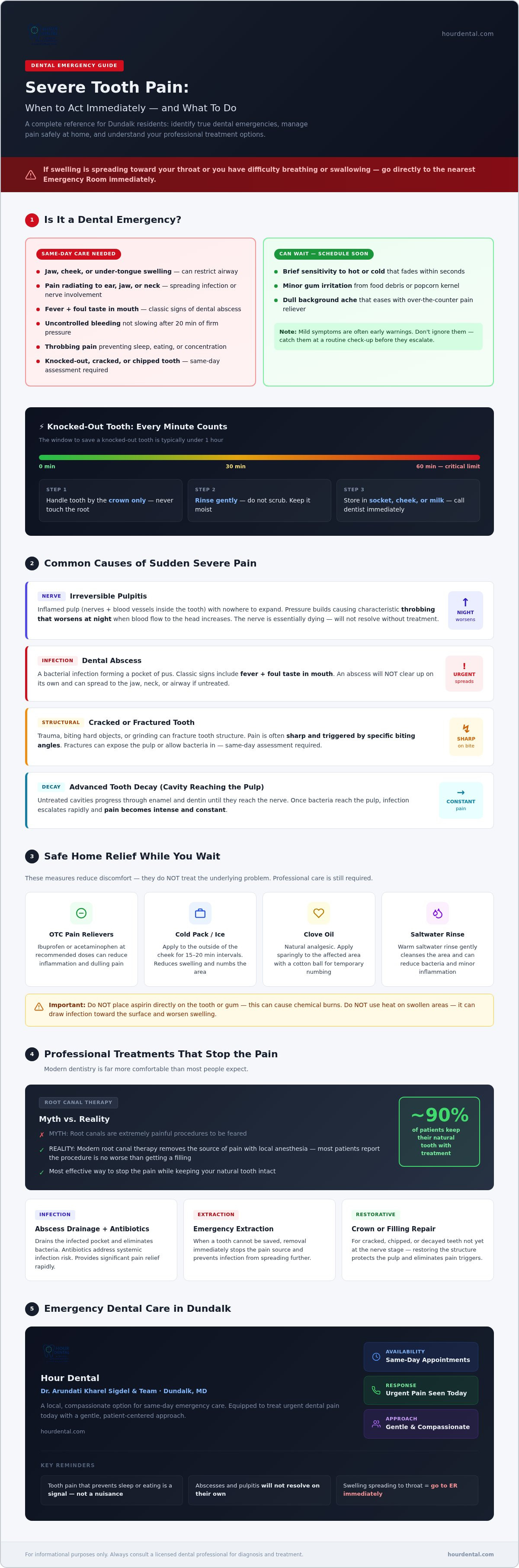
Trauma complicates things further. A cracked, chipped, or knocked-out tooth needs to be assessed the same day the injury occurs. If a tooth has been fully knocked out, handle it by the crown only, rinse it gently without scrubbing, and try to keep it moist, either by placing it back in the socket, holding it between your cheek and gum, or storing it in a small container of milk. The window for saving a knocked-out tooth is narrow, typically under an hour, so this is one situation where every minute counts.
Symptoms That Require Same-Day Care
Some symptoms move a toothache from "painful" to "potentially dangerous." If you're experiencing any of the following, seeking same-day severe tooth pain help isn't an overreaction; it's the right call:
- Visible swelling in the jaw, cheek, or under the tongue — swelling that pushes toward the floor of the mouth or throat can restrict your airway and requires immediate attention.
- Pain radiating to your ear, jaw, or neck — this pattern often signals a spreading infection or deep nerve involvement.
- Uncontrolled bleeding from the gums or a tooth socket — especially following an extraction or injury, bleeding that doesn't slow after 20 minutes of firm pressure warrants urgent care.
- Fever combined with a foul taste in your mouth — these are classic signs of a dental abscess, which is a bacterial infection that will not clear up on its own.
One important distinction: if swelling is spreading rapidly toward your throat, or you're having any difficulty breathing or swallowing, bypass the dental office entirely and go directly to the nearest emergency room. Hospitals are equipped to manage airway complications that fall outside a dental clinic's scope. For everything else on that list above, a same-day dental appointment is your fastest and most appropriate path to relief.
When is a Toothache Not an Emergency?
Not every ache demands an urgent response. Brief sensitivity to hot or cold that fades within a few seconds, minor gum irritation from a popcorn kernel or food debris, or a dull background ache that eases with an over-the-counter pain reliever are generally not emergencies. That said, none of these should be ignored indefinitely. Mild symptoms are often early warnings of a developing problem, and catching them at a routine check-up is far less involved than treating them after they've escalated.
Common Culprits: Why Your Tooth Pain Is Suddenly Severe
Tooth pain rarely appears without a reason, even when it feels like it came out of nowhere. That sudden, breathtaking throb you felt this morning most likely has a specific biological cause, and identifying it matters because different causes require different treatments. Here are the four most common reasons pain escalates from a minor annoyance to a full-blown crisis.
Irreversible pulpitis is one of the most frequent triggers of intense, spontaneous tooth pain. Inside every tooth is a soft core called the pulp, which contains nerves and blood vessels. When bacteria or trauma irritate that pulp severely enough, it becomes inflamed. Because the pulp is enclosed within hard tooth structure, there's nowhere for that swollen tissue to expand. The pressure builds with nowhere to go, creating the characteristic throbbing that worsens at night when you lie down and blood flow to the head increases. Unlike early-stage inflammation, irreversible pulpitis won't calm down on its own. The nerve is essentially dying, and only professional treatment can stop the cycle.
A dental abscess takes things a step further. This is a pocket of bacterial infection that forms at the root tip or in the surrounding gum tissue. The body sends immune cells to fight the infection, and the resulting buildup of pressure creates a deep, constant ache that can radiate into the jaw, ear, or neck. A fever or a salty, foul taste in your mouth alongside the pain are strong indicators you're dealing with an abscess. This is precisely the kind of situation where finding reliable severe tooth pain help quickly is essential, because an untreated abscess can spread beyond the tooth.
Impacted wisdom teeth tend to announce themselves loudly, often in a person's late teens or twenties. When a third molar doesn't have enough room to fully emerge, it can push against neighboring teeth, trap food and bacteria beneath the gum line, and generate significant inflammation in the back of the mouth. The pain is often dull and persistent but can spike sharply when biting down.
Failed restorations are an underappreciated cause of sudden pain. An old crown or filling that cracks, loosens, or wears down can expose the sensitive dentin layer underneath, leaving the nerve vulnerable to temperature, pressure, and bacteria. If a tooth you've had treated before suddenly starts aching again, the restoration itself deserves a close look.
The Role of Tooth Decay and Cavities
Cavities don't hurt at first, and that's part of what makes them dangerous. Bacteria produce acids that slowly eat through the outer enamel layer, which has no nerve endings, so the process is completely silent in its early stages. Once that decay reaches the dentin, the softer layer beneath the enamel, you'll start to notice sensitivity to sweets and cold drinks. That's the "twinge" phase. If the decay continues inward to the pulp, the twinge becomes a throb, and you've moved into pulpitis territory. The speed of that progression depends on the size of the cavity and how acidic the oral environment is.
Hidden Causes: Grinding and Sinus Pressure
Not every toothache originates inside the tooth. Bruxism, the habit of grinding or clenching your teeth, often happens during sleep without any awareness. Over time, the repeated force creates microscopic fractures in the enamel and wears down protective surfaces, leaving teeth hypersensitive and prone to cracking. Many Dundalk residents also experience a seasonal wrinkle: sinus pressure from spring allergies or a winter sinus infection can cause significant pain in the upper back teeth, because the roots of those molars sit directly beneath the sinus cavity. What feels like a toothache may actually be sinus inflammation pressing on those roots. This referred pain pattern is one reason a professional diagnosis matters so much before any treatment begins.
If any of these causes sound familiar, the team at Hour Dental in Dundalk can identify the source of your pain quickly and walk you through the most comfortable path to relief.
Immediate Steps for Relief: Safe Home Care While You Wait
While professional care is the only real solution for severe tooth pain, there are safe, practical steps you can take right now to make the next few hours more bearable. Think of these measures as a bridge, not a destination. They won't fix what's causing the pain, but they can reduce your discomfort enough to function while you arrange an appointment.
Saltwater rinse. Dissolve half a teaspoon of table salt in eight ounces of warm water and swish gently for 30 seconds. Salt draws excess fluid from inflamed tissue and reduces the bacterial load around an irritated tooth. It won't eliminate an infection, but it creates a cleaner, less hostile environment in your mouth. Repeat every few hours as needed.
Cold compress. Wrap a bag of ice or a frozen vegetable pack in a thin cloth and hold it against the outside of your cheek for 15 to 20 minutes at a time. Cold constricts blood vessels, which reduces swelling and temporarily numbs the area. Never apply ice directly to the skin, and don't place anything cold inside your mouth against the tooth itself, since extreme temperature can intensify the pain when the nerve is already inflamed.
Over-the-counter pain relief. Ibuprofen is often the most effective option for dental pain because it addresses both the pain signal and the underlying inflammation simultaneously. Take it strictly according to the label instructions. Paracetamol (acetaminophen) is a reasonable alternative if ibuprofen isn't suitable for you. One critical warning: never place an aspirin tablet directly on your gum tissue. This is a surprisingly common mistake, and it causes a chemical burn to the soft tissue that creates a painful secondary problem on top of the one you're already dealing with.
Finding reliable severe tooth pain help also means knowing what not to do. Avoid very hot drinks, cold foods, and anything hard or chewy until you've been seen by a dentist. These aren't just uncomfortable; they can worsen an already compromised tooth.
Stabilizing a Damaged Tooth
If a filling has fallen out or a tooth has cracked and left a sharp edge, temporary dental cement from a pharmacy can cover the exposed area and reduce sensitivity. Sugarless gum works as a short-term substitute if cement isn't available. For a knocked-out tooth, keep it moist by placing it back in the socket, between your cheek and gum, or in a small container of milk. Don't scrub it. Get to a dentist immediately.
Positioning for Sleep
Lying completely flat increases blood pressure in the head and often transforms a manageable ache into a throbbing that makes sleep impossible. Prop yourself up with two or three extra pillows to keep your head elevated above heart level. This simple adjustment can meaningfully reduce the intensity of nighttime pain. One more thing: resist the urge to spend those hours searching your symptoms online. Late-night googling rarely produces reassurance and almost always amplifies anxiety. You already know you need care; the goal right now is rest.
Professional Treatments: How Modern Dentistry Stops the Ache
Home remedies buy you time. Professional treatment actually solves the problem. Once you're in the chair, the path to relief is faster and more comfortable than most people expect, largely because modern dentistry has moved well beyond the intimidating experiences some patients remember from years past. Here's what the most common emergency treatments actually involve, and why each one works.
Root canal therapy remains the gold standard for saving a tooth when the pulp has become irreversibly inflamed or infected. The procedure removes the damaged nerve tissue, cleans and shapes the inner canal, and seals the tooth to prevent reinfection. The critical thing to understand is that a root canal doesn't cause pain; it ends it. The nerve causing your agony is removed during the procedure, so most patients leave the appointment feeling dramatically better than when they arrived. The tooth is preserved, the infection is eliminated, and you keep your natural bite.
Emergency extractions become necessary when a tooth is too structurally compromised or severely infected to save. This isn't a failure; it's sometimes the fastest and most responsible route to eliminating an active infection that could otherwise spread. Removing the tooth cuts off the source of the problem immediately.
Emergency crown repair addresses situations where a crown has cracked, fractured, or dislodged, leaving the underlying tooth exposed and vulnerable. Restoring that protective covering stops sensitivity and prevents bacteria from reaching the inner structure of the tooth.
Incision and drainage is the direct treatment for a painful dental abscess. The dentist makes a small opening in the swollen tissue to release the trapped infection, which provides near-immediate pressure relief. This procedure is typically paired with a course of antibiotics to address any remaining bacterial infection.
What to Expect During an Emergency Visit
Your appointment will begin with diagnostic X-rays to pinpoint exactly where the problem originates, since the source of pain isn't always the tooth that hurts most. From there, local anesthesia is administered before any treatment begins, ensuring the procedure itself is completely painless. At Hour Dental, the team is experienced in gentle dental care in Baltimore, with a particular focus on keeping anxious patients comfortable throughout every step. If nerves are part of your situation, mention it. Dr. Kharel Sigdel's team adjusts their approach accordingly.
Restoring Your Smile After the Pain
Emergency treatment stops the immediate crisis, but follow-up care protects your long-term oral health. A tooth that's had root canal therapy typically needs a porcelain crown placed over it to restore full strength and function. If an extraction was necessary, it's worth discussing your tooth replacement options in Dundalk sooner rather than later, since gaps left by missing teeth can shift neighboring teeth over time. Scheduled follow-up visits also allow your dentist to confirm the infection has fully cleared, which is the step most patients skip and later regret.
Finding reliable severe tooth pain help means connecting with a team that treats the emergency and plans for what comes next. Contact Hour Dental in Dundalk to get the care your tooth needs today.
Emergency Dental Care in Dundalk: Getting Help Today at Hour Dental
When severe tooth pain has you counting the hours until morning, the last thing you need is a phone tree, a week-long wait, or a clinical environment that makes your anxiety worse. Hour Dental in Dundalk is built around a different premise: that urgent dental pain deserves a same-day response from a team that genuinely knows your community. Dr. Arundati Kharel Sigdel leads the practice with a hands-on, patient-first philosophy, prioritizing clear communication, gentle technique, and transparent pricing so you're never left guessing about what's happening or what it will cost.
That combination matters more than it might sound. Many patients who put off finding severe tooth pain help do so because they're worried about being judged, rushed, or handed a bill they can't manage. At Hour Dental, the approach is straightforward: triage your situation quickly, explain your options honestly, and get you comfortable as fast as possible. Affordable restorative care, including root canal treatment, porcelain crowns, and extractions, is available with pricing discussed openly before any procedure begins.
Convenient Location for Baltimore and Essex Residents
Hour Dental sits on North Point Blvd with easy access and ample parking, making it a practical choice whether you're coming from Dundalk, Rosedale, Essex, or Highlandtown. The office has become a familiar stop for multi-generational families across these neighborhoods, from grandparents needing denture repairs to young adults dealing with their first dental emergency. The environment is calm and welcoming by design, because the team understands that dental anxiety is real, and that a relaxed atmosphere is part of the treatment.
Contact Us for Immediate Assistance
Don't wait until the pain becomes unbearable. Call the Hour Dental office as soon as you recognize the warning signs discussed throughout this guide. The team can triage your situation over the phone, help you understand whether your symptoms require same-day attention, and get you scheduled without unnecessary delays. Walk-in patients with urgent needs are accommodated based on availability, and the front desk staff are experienced at identifying cases that shouldn't wait.
You don't have to suffer through another sleepless night wondering whether your pain will be better by morning. It won't resolve on its own, and you deserve real relief today. Contact Hour Dental in Dundalk now, and let Dr. Kharel Sigdel's team put a proper end to your pain.
Your Path to Relief Starts With One Call
Severe tooth pain doesn't improve on its own, and this guide has given you the tools to understand why. You now know how to recognize a true dental emergency, which home measures can safely carry you through the next few hours, and what modern treatment actually looks like once you're in the chair. The pain you're feeling has a cause, and that cause has a solution.
Finding real severe tooth pain help in Dundalk means connecting with a team that's ready for you today. Dr. Arundati Kharel Sigdel and the Hour Dental team offer same-day emergency appointments for residents across Dundalk, Essex, and the surrounding Baltimore area, with a gentle approach designed to keep even anxious patients comfortable from the first moment to the last.
You've already done the hard part by educating yourself. Now take the next step. Call Hour Dental now for same-day emergency relief and let a trusted local team put a real end to your pain today.
Frequently Asked Questions About Severe Tooth Pain
How can I stop severe tooth pain at home instantly?
No home remedy will eliminate the underlying cause, but a few measures can reduce the intensity quickly. Take ibuprofen according to label instructions, since it targets both pain and inflammation simultaneously. Apply a cold compress to the outside of your cheek in 15-minute intervals. A warm saltwater rinse can also calm irritated tissue. These steps are a bridge to professional care, not a substitute for it.
Is severe tooth pain a medical emergency that requires the ER?
Most dental pain belongs in a dental office, not an emergency room, because hospitals typically can't perform dental procedures. The critical exception is swelling that's spreading toward your throat or any difficulty breathing or swallowing; those symptoms require the ER immediately. For everything else, including abscesses, severe throbbing, and facial swelling limited to the cheek or jaw, a same-day dental appointment is the fastest path to real relief.
What is the best painkiller for an unbearable toothache?
Ibuprofen is generally the most effective over-the-counter option for dental pain because it reduces inflammation at the source, not just the pain signal. If ibuprofen isn't suitable for you due to stomach sensitivity or other health reasons, acetaminophen is a reasonable alternative. Never place aspirin directly against your gum tissue; it causes a chemical burn that creates a second painful problem alongside the one you're already managing.
Can a sinus infection cause severe tooth pain?
Yes, and this is more common than most people realize. The roots of the upper back molars sit directly beneath the sinus cavity, so when the sinuses become inflamed from an infection or seasonal allergies, the pressure presses against those roots and mimics a toothache. The key distinction is that sinus-related pain typically affects multiple upper teeth at once and often comes with nasal congestion or pressure across the cheekbones. A dental exam can confirm whether the tooth or the sinus is the actual source.
How much does an emergency dental visit cost in Baltimore?
We don't publish specific pricing here because costs vary depending on the treatment required, and quoting a number without examining your situation wouldn't be accurate or fair to you. What we can say is that at Hour Dental in Dundalk, pricing is discussed openly before any procedure begins so you're never surprised. Call the office directly and the team can give you a clear picture of what to expect based on your specific needs.
What happens if I ignore a throbbing toothache?
A throbbing toothache almost always signals nerve involvement or active infection, and neither condition improves without treatment. Left untreated, a dental abscess can spread to the jaw, neck, or surrounding bone. Beyond the health risk, the longer an infection persists, the more complex and costly the eventual treatment becomes. Getting proper severe tooth pain help early is almost always the simpler, less expensive outcome compared to waiting until the situation escalates.
Will a root canal hurt if my tooth is already in severe pain?
This is one of the most common fears patients bring to our office, and the honest answer is reassuring. Local anesthesia is administered before the procedure begins, so the treatment itself is painless. The nerve tissue causing your agony is removed during the root canal, which means most patients feel significant relief by the time they leave the chair. The procedure ends the pain; it doesn't cause it. Any mild soreness afterward typically responds well to over-the-counter pain relievers for a day or two.
How do I know if my tooth pain is caused by an abscess?
An abscess tends to produce a deep, constant ache rather than sharp sensitivity to temperature or pressure. The clearest warning signs are a fever accompanying the toothache, a salty or foul taste in your mouth that comes and goes, and visible swelling in the cheek or jaw that feels warm to the touch. Pain that radiates into the ear, jaw, or neck is also a common pattern. If any of these sound familiar, don't wait; an abscess requires professional drainage and treatment to resolve safely.


