
Imagine sitting down for a meal at your favorite spot near Heritage Park, only to find yourself hesitating before every bite because of a missing tooth. It's a common struggle that many of our neighbors face, and it often leads to a difficult choice between a dental bridge vs partial denture. You might feel a bit overwhelmed by the technical talk or worried about how much these treatments will change your daily routine. We understand that you simply want to feel like yourself again without any unnecessary stress or confusion.
It's completely normal to feel a mix of hope and hesitation when you're looking for a way to restore your smile and your confidence. We've helped many families across Dundalk find the right balance between comfort and lasting value. This guide will walk you through the key differences in how these solutions feel, how long they last, and what they mean for your budget. By the time you finish reading, you'll have a clear path toward a natural-looking smile that lets you eat, speak, and laugh with total ease.
Key Takeaways
- Learn why a fixed bridge offers a stronger bite force and a "set it and forget it" convenience compared to the daily removal required for dentures.
- Understand how the choice of a dental bridge vs partial denture impacts your long-term oral health, including how bridges can actually strengthen weak neighboring teeth.
- Discover why partial dentures often serve as a more affordable initial investment while bridges provide a longer lifespan of up to 15 years.
- Find out how modern materials ensure your restoration looks natural and blends seamlessly with your existing smile for a boost in confidence.
- Get expert guidance on which solution fits your lifestyle and budget from a trusted Dundalk team dedicated to gentle, personalized care.
Choosing Between a Dental Bridge vs. Partial Denture in Dundalk
Losing a tooth is more than just a cosmetic concern; it's a functional challenge that affects how you enjoy a meal at a local Dundalk crab shack or chat with neighbors near the waterfront. When a gap is left empty, your remaining teeth often begin to drift out of alignment, which can lead to bite problems and jaw discomfort over time. This is why deciding on a dental bridge vs partial denture is a vital step for your long-term health. Both options are core components of Prosthodontics, a specialized field focused on restoring the function and beauty of your smile through high-quality replacements. Our goal is to help you find a solution that fits your busy Baltimore lifestyle while respecting your family's budget.
The choice between these two treatments often depends on the health of your surrounding teeth and your personal preference for a fixed or removable device. A bridge offers a permanent feel, while a partial denture provides a non-invasive way to restore multiple gaps at once. We want you to feel confident in your decision, knowing that either path leads to a more functional, natural-looking smile. By addressing tooth loss early, you protect the integrity of your jaw and ensure that your remaining natural teeth stay exactly where they belong.
What is a Fixed Dental Bridge?
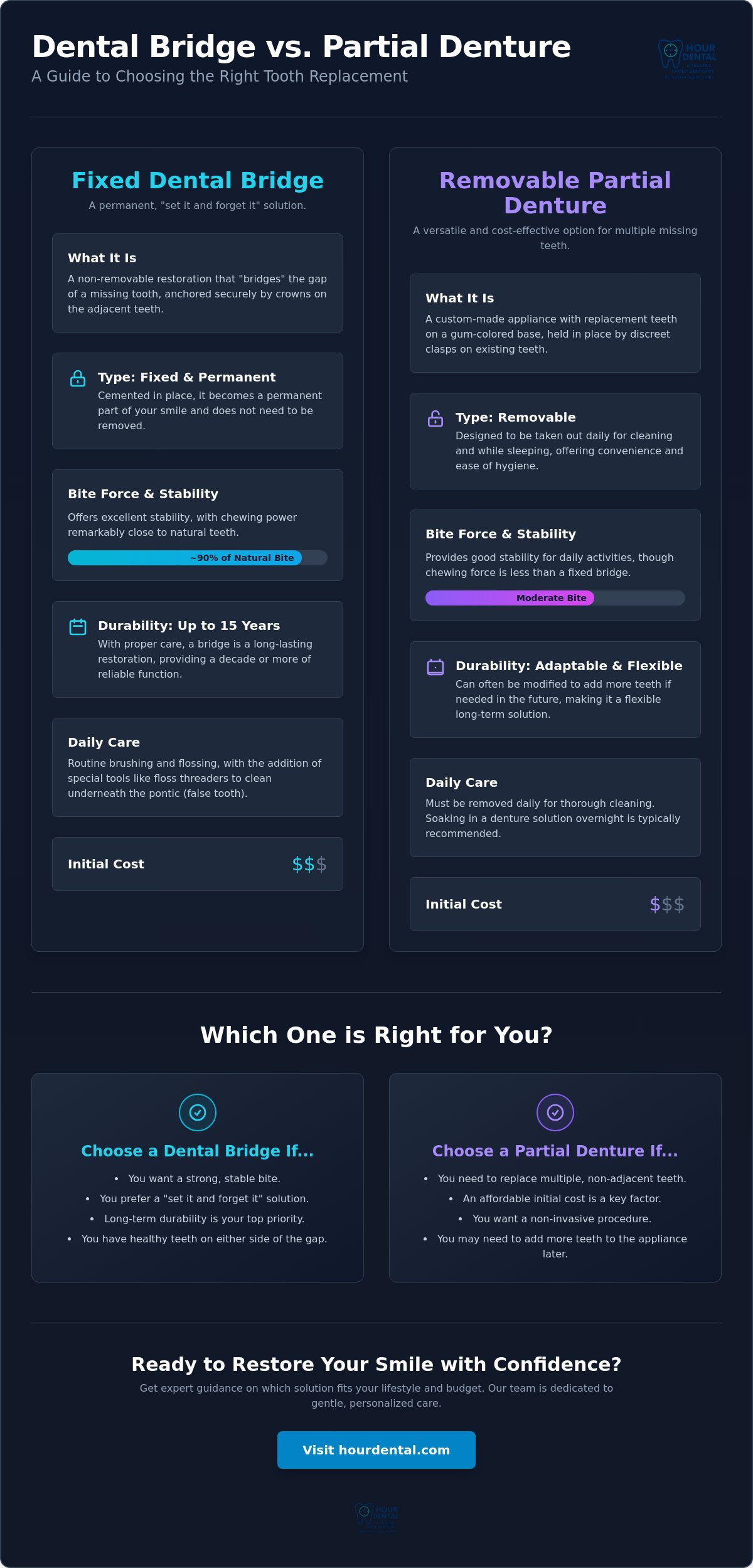
A fixed dental bridge is a sturdy, non-removable restoration that literally "bridges" the space where a tooth is missing. It consists of a pontic, which is the custom-crafted false tooth, held securely in place by abutment teeth on either side. These supporting teeth are fitted with durable porcelain covers to provide a strong foundation. Because it's cemented into place, a bridge feels like a permanent part of your natural dentition, allowing you to chew and speak without worrying about the device shifting. If you're interested in the details of the capping process, our affordable dental crowns Baltimore guide offers a deeper look at how we restore individual teeth.
What is a Removable Partial Denture?
A removable partial denture is a versatile appliance designed to replace one or several missing teeth in the upper or lower jaw. These devices typically feature an acrylic or metal base that's carefully matched to the color of your natural gums for a seamless look. They stay in place using discreet clasps that attach to your existing natural teeth, providing stability during daily activities. One significant advantage of a partial denture is its adaptability. If you happen to lose another tooth in the future, our team can often add a new replacement tooth to your existing device, making it a flexible and cost-effective long-term solution for many families in our community.
Comfort and Stability: Fixed Bridges vs. Removable Partials
When you're deciding on a dental bridge vs partial denture, the way each one feels during your daily routine is often the most important factor. A fixed bridge offers a "set it and forget it" experience because it's bonded directly to your supporting teeth. You won't have to worry about it shifting while you're talking or laughing with friends. On the other hand, a partial denture is a removable appliance that requires a bit more daily attention. While modern partials are designed to be lightweight, they do cover a small portion of your gums or the roof of your mouth, which can feel slightly bulky at first.
Stability directly impacts your ability to eat the foods you love. Research regarding the clinical effectiveness of dental bridges shows they provide excellent stability and a bite force that's remarkably close to your natural teeth. Because they're anchored in place, bridges typically offer a stronger chewing efficiency than removable options. Both choices require a short speech adjustment period as your tongue learns to navigate the new restoration. Dr. Sigdel takes great care to ensure every restoration we provide feels as natural as possible. She uses precise measurements to create a comfortable fit for our Dundalk patients, helping you speak and eat with total confidence.
The Daily Experience with a Bridge
Living with a bridge means you can enjoy a full menu without hesitation. You'll have no fear of the restoration slipping while eating at a Baltimore crab house or enjoying a family dinner. For hygiene, you'll use specialized tools like floss threaders to clean the area beneath the replacement tooth. In this context, the pontic is the custom-crafted artificial tooth that replaces your missing natural tooth while resting gently against the gumline. Keeping this area clean is essential for the long-term health of your smile.
The Daily Experience with a Partial Denture
Partial dentures offer great versatility, but they come with a different rhythm. You'll need to remove the appliance every night to give your gum tissues a chance to rest and stay healthy. This nightly break is vital for preventing irritation or infections. Cleaning happens outside the mouth using specialized brushes and gentle cleansers to keep the material fresh. You'll also notice the sensation of small clasps that secure the device to your supporting teeth. If you're feeling unsure about which fit is right for your lifestyle, we invite you to schedule a visit with our team to explore your options in person.
Long-Term Oral Health: How Each Option Affects Your Smile
Choosing between a dental bridge vs partial denture isn't just about how you look today; it's about how your mouth will function ten years from now. One common concern we hear from our Dundalk neighbors involves the preparation of neighboring teeth for a fixed bridge. While it's true that these abutment teeth must be shaped to fit the crowns, this process often serves a dual purpose. If those teeth already have large, aging fillings or minor cracks, crowning them actually provides a protective shield that strengthens them against future damage. It transforms a vulnerable tooth into a sturdy pillar for your new smile.
When you're exploring various tooth replacement options Dundalk, it's helpful to understand how each choice interacts with your remaining natural teeth. A bridge creates a solid, stable unit that prevents your other teeth from shifting into the empty space. Conversely, a partial denture relies on the strength of your existing teeth to stay in place. This requires meticulous hygiene because the metal or acrylic clasps can trap food particles and bacteria. Without careful cleaning, this can increase the risk of decay on the very teeth that hold your appliance in place.
Protecting Your Natural Teeth
Bridges are designed to distribute the pressure of your bite across the entire "bridge" structure, which helps take the load off individual teeth when you chew. Partial dentures are wonderful for their versatility, but the clasps that secure them can sometimes cause mechanical wear on the supporting teeth over many years. This is why staying consistent with your dental check up Dundalk is so important. These visits allow our team to monitor the health of your anchor teeth and make small adjustments to your appliance before minor wear becomes a larger problem.
Gum and Bone Considerations
Your jawbone needs constant stimulation from tooth roots to stay dense and healthy. When a tooth is missing, the bone in that specific area begins to thin over time. While neither a bridge nor a denture replaces the root itself, a bridge excels at preventing the "tipping" effect where adjacent teeth lean into the gap and ruin your bite alignment. It's important to remember that bone resorption begins naturally once the tooth root is no longer present to stimulate the jaw after a painless tooth extraction Baltimore. By choosing a replacement quickly, you maintain the structural harmony of your entire smile.
Cost, Durability, and Procedure: What to Expect in 2026
When weighing the choice of a dental bridge vs partial denture, the financial aspect is often a top priority for our neighbors in Essex and Dundalk. We believe that everyone deserves a healthy smile, so we focus on helping you understand the long-term value of your investment. Generally, partial dentures represent the most accessible entry point for replacing missing teeth. This makes them an excellent choice if you need a functional solution quickly. However, a fixed bridge involves more intricate clinical work and high-quality materials like porcelain, which often results in a higher initial cost but offers distinct advantages in durability.
The materials used in the Baltimore dental market play a significant role in how your restoration looks and feels over time. Most fixed bridges are crafted from medical-grade porcelain or zirconia to mimic the light-reflecting properties of natural enamel. Partial dentures typically use a combination of acrylic and metal, though modern flexible options are also available. While a bridge is designed to be a long-lasting fixture in your mouth, a denture is a removable tool that will eventually need professional maintenance to keep it fitting correctly as your gum line changes.
Investment vs. Longevity
Thinking about the "cost per year" can help you see the bigger picture of your dental health. A well-maintained dental bridge often lasts between 10 and 15 years, providing a stable and reliable solution for active patients who don't want to worry about their teeth. Removable partial dentures generally have a shorter lifespan of 5 to 10 years before they require relining or a full replacement. Most dental insurance plans classify both options as major restorative procedures, often covering a portion of the cost after your deductible is met. For many younger or more active individuals, the permanent nature of a bridge provides a sense of security that outweighs the higher upfront investment.
The Treatment Timeline
The path to your new smile varies depending on the restoration you choose. A dental bridge typically requires only two or three visits to our office. During the first visit, we gently prepare the supporting teeth and take precise impressions. We'll provide a temporary bridge to protect your smile while your custom piece is crafted in a professional laboratory. Once it's ready, you'll return for a final fitting where we ensure your bite feels natural and comfortable. Partial dentures often involve a few more stages, including multiple fitting appointments to ensure the clasps and base sit perfectly against your gums. If you're ready to find the most affordable and effective way to restore your smile, contact Hour Dental today to explore your personalized treatment plan.
Personalized Tooth Replacement at Hour Dental
Deciding on the right path for your smile involves more than just comparing a dental bridge vs partial denture on paper. It's about finding a team that understands your daily life and your specific goals for the future. Dr. Arundati Kharel Sigdel brings a unique blend of clinical authority and a warm, community-focused approach to every restorative case. She understands that the prospect of dental work can be daunting, so she prioritizes a gentle touch that alleviates common anxieties. Our practice isn't just a clinic; it's a local fixture where Dundalk and Essex families find the professional reassurance they need to move forward with lasting confidence.
We believe that high-quality restorative care should be accessible and affordable for everyone in our community. This commitment to accessibility is woven into everything we do, from our transparent guidance on costs to our focus on long-term value. We don't just see a missing tooth; we see a neighbor who wants to enjoy a meal at a local restaurant or speak clearly during a community meeting. By focusing on the positive life impact of our services, we move the conversation away from technical jargon and toward your personal well-being. Our goal is to provide a safe haven for those who have felt overwhelmed by their dental options in the past.
A Comfortable Environment for Restorative Care
We've worked hard to create a relaxing space for patients who might feel apprehensive about restorative procedures or the potential for discomfort. Our office near North Point Blvd is designed to be a welcoming environment for multi-generational families, where we serve everyone from grandparents to young adults. This focus on serving the entire family helps us build enduring, trust-based relationships that last for decades. We take the time to listen to your concerns about chewing efficiency or the fit of an appliance, ensuring your restorative journey is defined by neighborly hospitality rather than stress.
Ready to Restore Your Smile?
Dundalk residents continue to trust Hour Dental because we combine modern, high-tech solutions with traditional community values. We're dedicated to helping you achieve a natural-looking smile that stands the test of time, providing the clear guidance you need to choose between a fixed or removable solution. Whether you're looking for the stability of a bridge or the versatility of a partial, our team is here to support you every step of the way. Don't let a missing tooth hold you back from the life you love in Baltimore.
Taking the first step toward a healthier, more confident version of yourself is easy. We invite you to reach out and discover how our personalized approach can make a difference in your restorative experience. Schedule your restorative consultation at Hour Dental today!
Take the Next Step Toward a Brighter Smile
Choosing between a dental bridge vs partial denture is a personal decision that impacts your daily comfort and your long-term oral health. Whether you value the permanent, sturdy feel of a fixed bridge or the non-invasive versatility of a partial denture, the right choice is the one that makes you feel most like yourself. By addressing missing teeth now, you're protecting your jaw structure and ensuring your remaining natural teeth stay healthy and aligned for years to come.
At Hour Dental, we're dedicated to serving our neighbors in Dundalk, Essex, and the surrounding Baltimore communities with professional reassurance and a gentle touch. Led by Dr. Arundati Kharel Sigdel, DDS, our team prioritizes your comfort and provides clear guidance every step of the way. We even offer emergency same-day appointments to ensure you're never left waiting when you need care the most. We look forward to helping you regain your confidence and your ability to enjoy every meal with ease.
Restore your smile and confidence; book an appointment at Hour Dental in Dundalk!
Frequently Asked Questions
Is a dental bridge more expensive than a partial denture?
Yes, a dental bridge typically requires a higher initial investment than a removable partial denture. This is because bridges are custom-crafted from high-quality porcelain or zirconia and involve more intricate clinical preparation of the neighboring anchor teeth. While the upfront cost is higher, many Dundalk patients find that the long-term stability and the typical 10 to 15-year lifespan of a bridge offer excellent value for their daily comfort.
Can I eat normally with a partial denture?
You can enjoy most of your favorite foods with a partial denture, though there's usually a short adjustment period. It's helpful to start with softer foods and cut your meals into smaller, manageable pieces as you get used to the feel of the appliance. While you'll regain much of your chewing ability, it's best to be cautious with extremely sticky or hard foods that could potentially loosen the metal or acrylic clasps.
How long does it take to get used to a dental bridge?
Most patients feel completely comfortable with their new dental bridge within a few days to two weeks. Since the restoration is fixed and doesn't move, it quickly begins to feel like a natural part of your smile. You might notice a slight change in your speech or a different sensation when biting down at first, but these minor issues typically resolve as your tongue and cheeks adapt to the new structure.
Can a partial denture be turned into a permanent bridge later?
It's often possible to transition from a removable partial to a permanent bridge if your surrounding teeth are healthy enough to provide support. Many people choose to start with a partial denture as a budget-friendly entry point and then upgrade to a fixed bridge later for added stability and convenience. Dr. Sigdel can evaluate your oral health during a routine visit to determine if your anchor teeth can support a permanent restoration.
What happens if I don’t replace a missing tooth?
Leaving a gap in your smile can cause your remaining teeth to shift or "tip" into the empty space, which often ruins your bite alignment. This movement can lead to jaw discomfort, increased wear on other teeth, and make it harder to keep your mouth clean. Over time, the jawbone in the area of the missing tooth may also begin to thin, potentially complicating future replacement options if you wait too long.
Do dental bridges look like natural teeth?
Modern dental bridges are designed to be virtually indistinguishable from your natural teeth. We use advanced materials that mimic the translucency and light-reflecting properties of real enamel. By carefully matching the shade and shape to your surrounding teeth, we ensure your bridge looks beautiful and fits seamlessly into your smile. You can feel confident laughing and talking with friends at local Dundalk gatherings without anyone noticing a restoration.
How do I clean a dental bridge vs. a partial denture?
The cleaning routine for a dental bridge vs partial denture is quite different. You clean a bridge while it's in your mouth by brushing normally and using a floss threader to reach the area under the replacement tooth. A partial denture must be removed every night and cleaned with a specialized brush and gentle cleanser. It's also important to soak your denture in water overnight to keep the material from warping or becoming brittle.
Which option is better if I am missing multiple teeth in different areas?
A partial denture is generally the more versatile and cost-effective choice if you have several gaps in different areas of the same jaw. While a bridge is ideal for filling a single gap of one or two missing teeth, a single partial denture can replace multiple teeth across your entire arch. This makes it a highly efficient solution for restoring your ability to chew and speak clearly without needing multiple separate bridges.


